What Causes Lightning? How Storm Clouds Charge Up and Strike
Inside a thunderstorm, billions of ice particles collide and build up charge until the air gives way. Here is how that happens, why thunder follows and what the National Weather Service says to do.
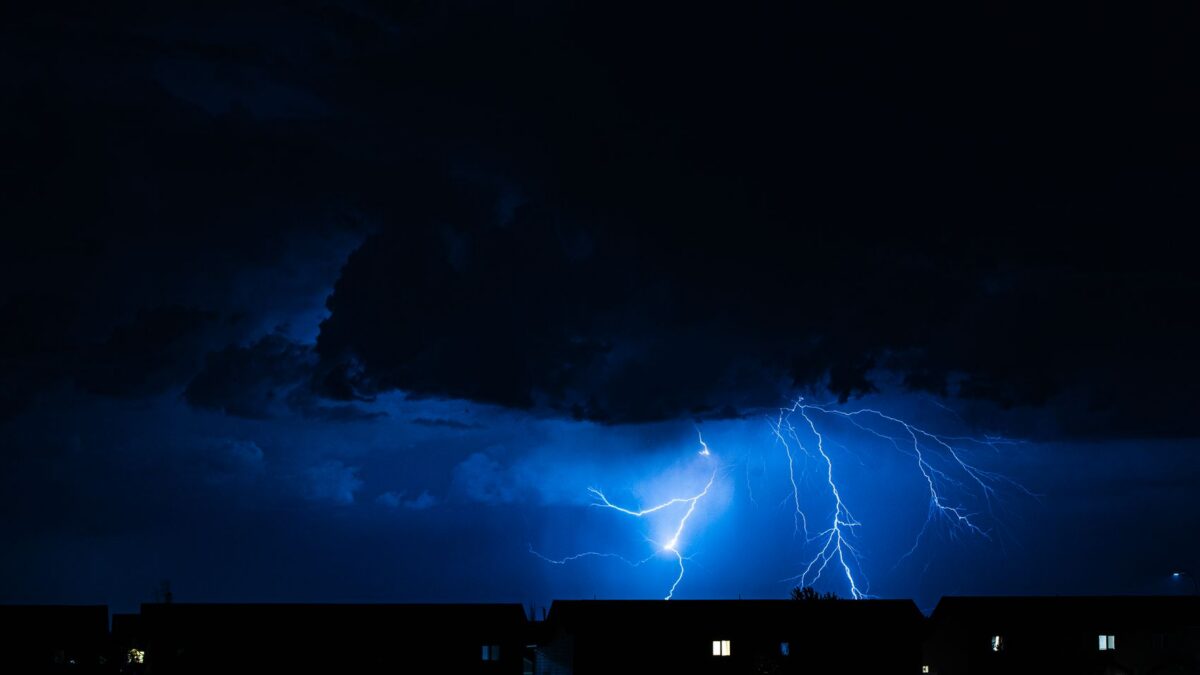
Lightning is a giant electric spark that forms when collisions between ice crystals and soft hail inside a thunderstorm separate positive and negative charge. When the difference grows large enough, the air breaks down and a channel of current flashes through it, heating the air to about 50,000°F (roughly 28,000°C), roughly five times hotter than the Sun’s surface, according to the National Weather Service.
That heat makes the air expand explosively, and the result is thunder. The National Weather Service estimates there are about 25 million lightning flashes a year in the United States, and lightning kills about 20 people in an average year.
How does a storm cloud build up electric charge?
Charge builds up when small ice crystals and graupel, soft pellets of hail, collide in the storm’s rising air. NOAA’s National Severe Storms Laboratory explains that graupel grows by collecting tiny supercooled water droplets. When graupel and smaller ice crystals bump and bounce apart, one picks up positive charge and the other negative.
Updrafts then sort them by size. The light ice crystals are carried higher, while the heavier graupel stays lower. According to NSSL, most storms end up with a large region of negative charge on graupel in the middle of the cloud and a region of positive charge on ice crystals near the top. A smaller positive region often sits below the main negative one.
Lab studies suggest the sign of the charge graupel picks up depends on temperature. Near the freezing point it tends to become positive; higher in the storm, where it is colder, it tends to become negative.
What happens during a lightning strike?
A strike happens when the electric field between charge regions becomes strong enough to break down the insulating air. Most flashes, if not all, start inside the cloud, NSSL says.
- Intracloud lightning jumps between opposite charges inside the same storm. It is the most common kind and lights up clouds from within.
- Cloud-to-ground lightning connects charge in the cloud with opposite charge on the ground.
In a cloud-to-ground flash, a faint branching channel works its way down from the cloud. When it gets within roughly 100 yards of the ground, objects below such as trees, poles and buildings send up sparks of their own. When one of those sparks connects, a large current surges through the channel, and that is the bright flash you see. Flashes often flicker because several pulses of current follow the same path in a fraction of a second.
Lightning can strike far from the storm itself. The National Weather Service says lightning can reach outward about 10 miles from a thunderstorm, which is why it can hit under blue sky.
What causes thunder, and how far away is the storm?
Thunder is the sound of air heated so fast by the lightning channel that it expands as a shock wave. Close to the channel this is a sharp crack; farther away it becomes a long rumble, because sound arrives from different parts of a channel that can be miles long.
Light reaches you almost instantly, while sound covers about one mile every five seconds. Count the seconds between flash and thunder and divide by five for the distance in miles (divide by three for kilometers).
| Seconds from flash to thunder | Approximate distance |
|---|---|
| 5 | 1 mile (1.6 km) |
| 10 | 2 miles (3.2 km) |
| 30 | 6 miles (10 km) |
| 50 | 10 miles (16 km) |
The National Weather Service says thunder can usually be heard about 10 miles from a strike, which is roughly the same distance lightning can reach from a storm. NSSL notes that under quiet conditions thunder can sometimes carry about 25 miles. In practice, if you can hear thunder, you are close enough to be struck.
What is the 30-second rule, and what do forecasters advise now?
The old 30-second rule said to take shelter if thunder followed lightning within 30 seconds, meaning the storm was within about 6 miles. Current National Weather Service advice is simpler: “When Thunder Roars, Go Indoors.” Since lightning can strike 10 miles from a storm, any thunder at all is the signal.
The weather service gives these outdoor basics:
- Get inside a building or a hard-topped vehicle as soon as you hear thunder. The NWS says there is no safe place outside when thunderstorms are in the area.
- Do not shelter in tents, dugouts or open-sided picnic shelters. They do not protect from lightning.
- Wait 30 minutes after the last rumble of thunder before going back out.
- If you are caught outside with no shelter, avoid hilltops, ridges, open fields and tall isolated trees, and stay away from water and metal fences or poles. These steps only slightly lower the risk.
- In a group, spread out so a single strike does not reach several people.
Lightning also shapes other outdoor plans. Launch teams watch charged clouds closely, and weather is one of the main reasons rocket launches get scrubbed.
How many people does lightning kill in the US each year?
Lightning killed an average of 20 people a year in the United States from 2016 to 2025, according to National Weather Service fatality records. The 2025 total was 21. As of November 2026, the weather service’s preliminary count for 2026 stood at 16, with the most recent death listed on Sept. 18 in Utah, where a hiker was sheltering in a small structure during a storm.
Hundreds more people are injured each year, the weather service says. Medical questions about lightning injuries are outside the scope of this article; the NWS lightning pages link to official guidance.
Each entry in that list gives the date, the place and what the person was doing when the storm arrived, which makes it a sober reminder that lightning risk comes with ordinary outdoor plans.
Bottom line
Lightning comes from charge that colliding ice particles separate inside a thunderstorm. A bolt heats air to about 50,000°F, which makes the thunder. It can strike about 10 miles from a storm, so the National Weather Service rule is to go indoors when you hear thunder and wait 30 minutes after the last rumble.
FAQ
Can lightning strike the same place twice?
Yes. The National Weather Service says lightning often strikes the same place repeatedly, especially tall, pointed, isolated objects, and it puts the Empire State Building’s average at about 23 strikes a year.
Is it safe to be in a car during lightning?
A hard-topped vehicle is one of the two shelters the National Weather Service recommends, along with a substantial building. Open-sided shelters, tents and dugouts do not protect you.
Why do some thunderstorms produce more lightning than others?
Storms with strong updrafts that carry lots of graupel and ice through the freezing level separate more charge. Tall, vigorous storms, like the supercells that can also produce tornadoes, tend to flash most often.
How long should I wait after a storm before going outside?
The National Weather Service says to wait 30 minutes after the last rumble of thunder. Lightning can still strike from the trailing edge of a storm that seems to be moving away.