How Fossils Are Dated: Rock Layers, Ash Beds and Isotopes
A dinosaur bone carries no date stamp. Geologists read the layers around it and the slow ticking of uranium and potassium in volcanic ash to work out its age.
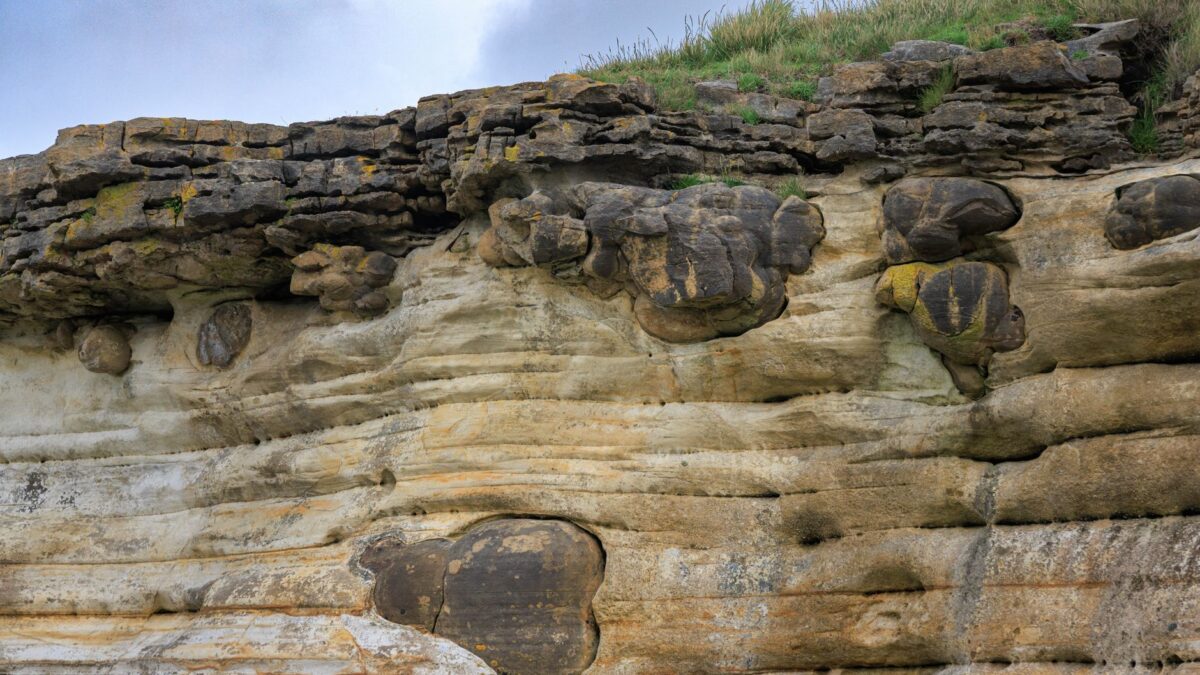
Most fossils are dated indirectly. Paleontologists first place a fossil in the sequence of rock layers around it, then date volcanic ash or lava layers above and below it using radiometric methods such as uranium-lead or argon-argon dating. Carbon-14 dating is not used for dinosaurs, because it only works on material younger than about 50,000 years.
The result is usually an age window, such as “younger than one ash bed but older than the next,” which can be narrow when ash layers sit close to the fossil.
What is relative dating?
Relative dating puts rocks and fossils in order without giving an age in years. It rests on a simple rule of layered rock: in undisturbed sediments, lower layers were laid down first and are older than the layers above them.
Fossils themselves help match layers across long distances. Some species lived for a short time but spread widely, so finding them pins a rock to a narrow slice of time. These are called index fossils. Ammonites, the coiled shells of extinct relatives of squid, and trilobites, ancient sea arthropods, are classic examples. If the same ammonite species turns up in rocks in two countries, those rocks formed at roughly the same time.
Relative dating built the geologic time scale, with its eras and periods, long before anyone could measure ages in years.
How does radiometric dating work?
Radiometric dating measures how much of a radioactive “parent” isotope in a mineral has turned into its stable “daughter” product. Each parent decays at a fixed rate, described by its half-life, the time it takes for half of it to decay. Measuring the ratio of daughter to parent gives the time since the mineral formed, as the US Geological Survey explains.
| Method | Parent to daughter | Half-life | Typical use |
|---|---|---|---|
| Uranium-lead | Uranium-238 to lead-206 | About 4.5 billion years | Zircon crystals in volcanic ash; very old rocks |
| Uranium-lead | Uranium-235 to lead-207 | 704 million years | Used together with U-238 as a cross-check |
| Potassium-argon and argon-argon | Potassium-40 to argon-40 | 1.25 billion years | Volcanic rocks from a few thousand to billions of years old |
| Radiocarbon | Carbon-14 to nitrogen-14 | 5,730 years | Once-living material younger than about 50,000 years |
Half-lives for uranium and potassium are from the USGS; the carbon-14 value is from NIST. Argon-argon dating is a refined version of the potassium-argon method that measures both isotopes in one sample. Uranium-lead dating works especially well on zircon, a tough mineral that forms in volcanic magma and locks in uranium but almost no lead when it crystallizes.
How do you date a fossil with volcanic ash?
Fossils usually lie in sedimentary rock such as sandstone or shale, which is made of older grains washed in from elsewhere. Dating those grains would give the age of the eroded source rock, not of the layer. So geologists look for volcanic ash beds or lava flows above and below the fossil, which crystallized at the time of the eruption.
- Map the rock layers and record exactly where the fossil sits.
- Find ash beds or lava flows below and above it in the same sequence.
- Collect crystals such as zircon or sanidine from each bed.
- Date them with uranium-lead or argon-argon methods in the lab.
- Report the fossil as younger than the lower bed and older than the upper one.
The University of California Museum of Paleontology’s Understanding Evolution site calls this bracketing: dating igneous rock or ash layers above and below a fossil gives the youngest and oldest it could be. Where ash beds sit close to a fossil, the window can be narrow.
Why isn’t carbon dating used for dinosaurs?
Carbon-14 decays too fast. With a half-life of 5,730 years, so little is left after about 50,000 years that it can no longer be measured reliably. Non-bird dinosaurs died out 66 million years ago, more than a thousand times beyond that limit.
There is a second problem. Radiocarbon dating needs carbon from the original organism, and in most dinosaur fossils the bone has been largely replaced or filled in by minerals over millions of years. Any carbon-14 detected in such a fossil would come from modern contamination, not from the animal.
Radiocarbon is the right tool for much younger remains: mammoth bones, ancient campfires, wood and textiles. It is also how researchers dated the eye lenses of Greenland sharks, described in our guide to the longest-living animals.
What other methods help date fossils?
Several other clocks fill the gaps where ash beds are missing:
- Magnetic reversals. Earth’s magnetic field has flipped many times. Rocks record the field direction when they form, and the pattern of normal and reversed layers can be matched to a dated global sequence.
- Biostratigraphy. Groups of index fossils, including microscopic plankton, give ages by matching to well-dated sections elsewhere.
- Methods for younger sites. For human-era fossils and caves, labs use uranium-series dating of cave deposits and luminescence dating of buried sand grains, along with radiocarbon.
Good studies use more than one method and report the age with its uncertainty, such as “66.0 plus or minus a few tens of thousands of years.”
How precise can fossil dates be?
Very precise near well-studied boundaries. Argon-argon dating of ash beds in Montana, published in Science in 2013, matched the Chicxulub impact and the mass extinction at the end of the Cretaceous to within about 32,000 years, a tiny fraction of 66 million. Our explainer on what killed the dinosaurs covers that event.
Far from any ash bed, a fossil’s age can be much less certain. That uncertainty is one reason the sizes and ages of giants like those in our guide to the biggest dinosaurs are quoted as ranges.
Bottom line
Fossils are dated by combining relative dating, which orders rock layers and uses index fossils, with radiometric dating of volcanic layers above and below the fossil. Uranium-lead and argon-argon methods cover millions to billions of years. Carbon-14 reaches back only about 50,000 years, so it is used for mammoths and ancient campsites, not dinosaurs.
FAQ
Can you date a dinosaur bone directly?
Usually not. Most dinosaur bones have been mineralized, so scientists date volcanic layers above and below the bone instead and give an age range.
How far back can carbon dating go?
About 50,000 years. After that, too little carbon-14 remains to measure reliably.
How accurate is radiometric dating?
For good samples it is very accurate; the 2013 dating of the end-Cretaceous ash beds had an uncertainty far below one percent of the age. Labs cross-check by using two uranium decay chains, repeating measurements and comparing different methods on the same layers.