What Is the Terracotta Army? China’s Clay Soldiers Explained
Rows of clay soldiers, each with its own face, have guarded a tomb for more than 2,200 years. Here is what archaeologists know, and why the emperor's mound is still closed.
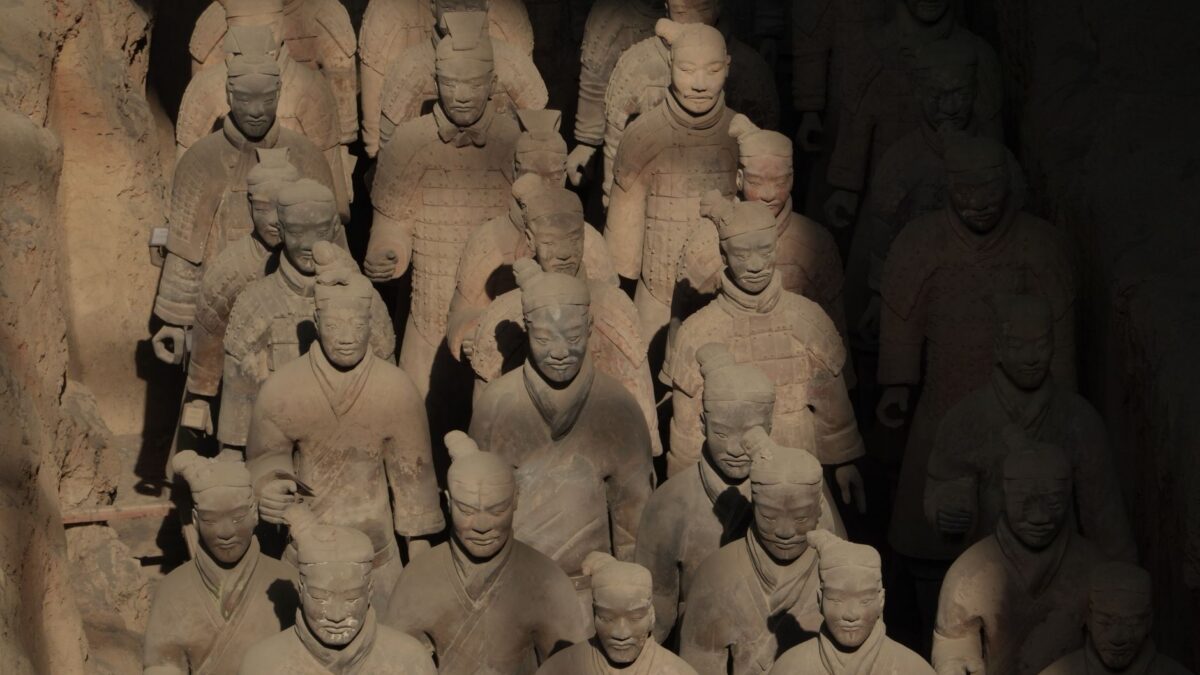
The Terracotta Army is a buried force of thousands of life-size clay soldiers, horses and chariots made to guard the tomb of Qin Shi Huang, the first emperor of a unified China, who died in 210 BC. Farmers found the first pieces in 1974 near Xi’an, in Shaanxi Province. Museums estimate the army at almost 8,000 figures, most still unexcavated.
The soldiers stand in battle formation in pits east of the emperor’s burial mound, which archaeologists have not opened.
How was the Terracotta Army discovered?
Local farmers came across fragments of clay figures in 1974 while digging, a find usually described as happening during work on a well. The National Museums Liverpool, which hosted a major exhibition of the figures, dates the discovery to 29 March 1974. Archaeologists soon realized the pieces belonged to a vast underground army.
The site sits at the northern foot of Lishan Mountain, about 35 km (22 miles) northeast of Xi’an, according to UNESCO, which added the Mausoleum of the First Qin Emperor to its World Heritage List in 1987.
Who was Qin Shi Huang?
Qin Shi Huang was the ruler who unified China’s warring states in 221 BC and declared himself its first emperor. Born Ying Zheng, he became king of the state of Qin as a boy and died in 210 BC. UNESCO notes that he imposed a single system of writing, money, weights and measures across his territory.
Work on his tomb began in 246 BC, the year he became king, and continued for decades. The historian Sima Qian, writing about a century later, described workers from every province laboring until the emperor’s death to build an underground city inside a huge mound. The surviving mound is 51.3 meters (168 feet) tall, UNESCO says, set within a double-walled enclosure.
How many soldiers are in the Terracotta Army?
Nobody knows the exact number, because most of the figures are still buried. National Museums Liverpool says the warriors are thought to number almost 8,000. They stand in three pits east of the mausoleum, with a fourth pit left empty. The figures average about 1.8 meters (5 feet 11 inches) tall and weigh between 110 and 300 kg (240 to 660 lb) each, according to the same source.
The warriors are only part of the complex. UNESCO describes nearly 200 accompanying pits with soldiers, horses, bronze chariots and weapons, and more than 600 sites in total across a protected area of 56.25 square kilometers (about 22 square miles).
| Feature | Figure | Source |
|---|---|---|
| Estimated warriors | Almost 8,000 | National Museums Liverpool |
| Average height of a warrior | About 1.8 m (5 ft 11 in) | National Museums Liverpool |
| Weight of a warrior | 110 to 300 kg | National Museums Liverpool |
| Height of the burial mound | 51.3 m (168 ft) | UNESCO |
| Protected area | 56.25 sq km | UNESCO |
| Emperor’s death | 210 BC | UNESCO |
How were the soldiers made, and why do they look different?
The figures were mass-produced in workshops but finished by hand, which gave them individual features. UNESCO describes the figures as all different, hyper-realistic down to uniforms, weapons and horses’ halters. Workers built them from standardized parts, then added details to heads, hair, faces and armor.
Researchers have tried to measure how individual they really are. A 2014 study in the Journal of Archaeological Science, by a team led by archaeologists at University College London, used photographs to build 3D models of the ears of 30 warriors. No two ears matched. The researchers cautioned that 30 ears out of thousands is a small sample, and that the variation could reflect real individuals, workshop habits or both.
The army also carried real weapons. UCL reports that spears, lances, swords, crossbow triggers and as many as 40,000 bronze arrowheads have been recovered.
Were the warriors painted?
Yes. The soldiers were originally colorful. According to Marcos Martinón-Torres, lead author of a 2019 study in Scientific Reports, the warriors and most organic materials in the mausoleum were coated with protective lacquer and then painted with pigments. Most figures look gray today because the paint and lacquer have largely flaked away over two millennia.
The same study corrected a popular story. Chromium found on the surface of some bronze weapons had been taken as evidence of an ancient anti-rust coating. The team found the chromium came from lacquer on nearby wooden and bamboo parts, such as spear shafts and sword grips, and suggested the local soil helped preserve the bronze.
Why hasn’t the emperor’s tomb been opened?
Chinese archaeologists have surveyed the mound but have chosen not to excavate the burial chamber. A frequently given reason is preservation: paint, lacquer and other fragile materials can deteriorate once exposed, and the techniques to protect everything inside may not yet be good enough.
There is also the question of mercury. Ancient records say the tomb chamber held large amounts of liquid mercury. A 2020 study in Scientific Reports summarized earlier soil surveys that found raised mercury levels over the mound, up to 1,440 parts per billion in one survey. The same study used laser radar to measure mercury in the air and found that the mausoleum did not add significantly to atmospheric mercury in the area. Soil readings hint at mercury below, but only excavation could confirm what is inside.
Other ancient monuments raise similar questions about how, and by whom, they were built. We look at the Egyptian evidence in how the pyramids were built, and at dating methods in how carbon dating works.
Bottom line
The Terracotta Army is an estimated army of almost 8,000 life-size clay soldiers, plus horses, chariots and real bronze weapons, buried to guard the tomb of Qin Shi Huang, who died in 210 BC. Found by farmers in 1974 near Xi’an, it was originally painted and is part of a much larger UNESCO World Heritage site. The emperor’s own burial chamber remains unopened.
FAQ
Are all the terracotta warriors’ faces different?
UNESCO describes the figures as all different. A 2014 study of 30 warriors found no two ears alike, though the authors said the sample is too small to prove every figure is unique or based on a real person.
Can you visit the Terracotta Army?
Yes. The pits are part of the Emperor Qinshihuang’s Mausoleum Site Museum near Xi’an, where several excavated pits are covered by exhibition halls. Selected figures also travel to museum exhibitions abroad.
Why are the warriors gray if they were painted?
The figures were coated with lacquer and painted, but most of that surface has flaked off during more than 2,000 years underground and after excavation. Traces of color survive on some figures.
Is there really mercury in the tomb?
Ancient records say so, and soil surveys over the mound have found raised mercury levels. Scientists cannot confirm the contents of the chamber without excavating it.