What Is Max Q? A Falcon 9 Launch Timeline Explained Step by Step
Launch webcasts call out Max Q, MECO, stage separation and the entry burn in quick succession. This is what each one means and roughly when it happens on a Falcon 9.
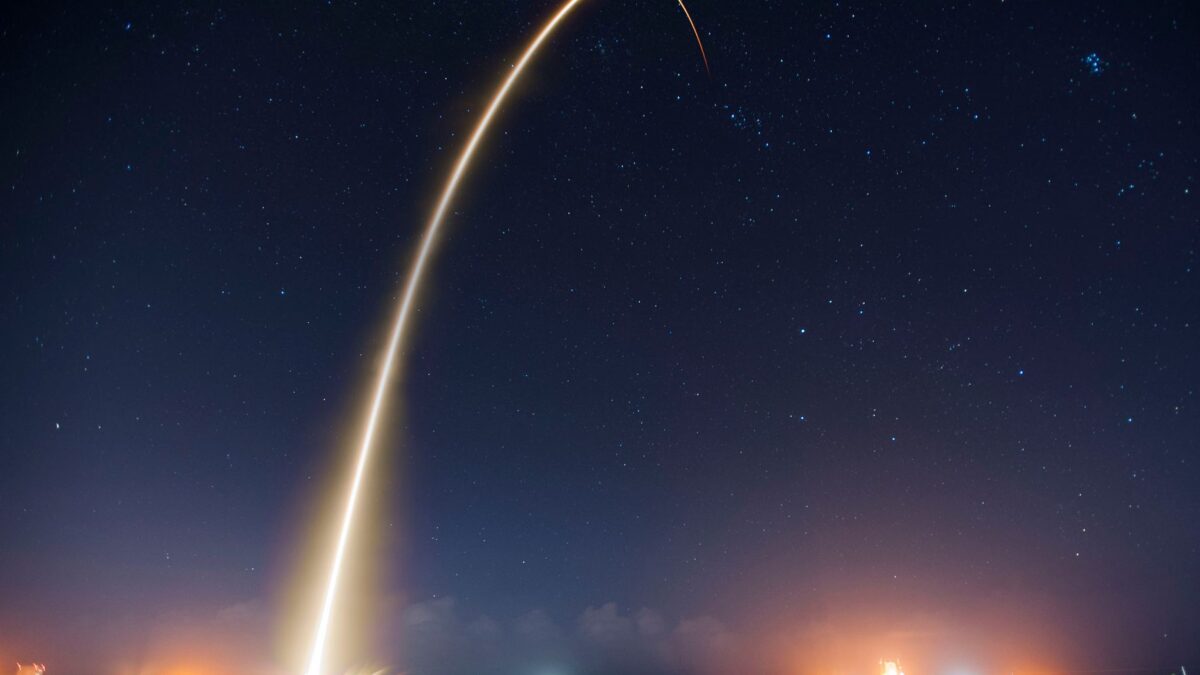
Max Q is the point in a launch when the air pushes hardest on the rocket. It comes from a mix of rising speed and thinning air and, on a SpaceX Falcon 9, usually arrives a little over one minute after liftoff. After Max Q, the forces on the vehicle drop quickly as it climbs into thinner atmosphere.
Webcast hosts call out a string of these milestones in the first ten minutes. Each one marks a stage of the climb, and once you know the order, a launch is much easier to follow.
What does Max Q actually mean?
Max Q stands for maximum dynamic pressure, the peak of the aerodynamic load on the rocket during its climb. Engineers write dynamic pressure as the letter q. It depends on air density and on the square of the rocket’s speed.
At liftoff the air is thick but the rocket is slow, so q is low. A minute later the rocket is going much faster while the air is still fairly dense, and q peaks. After that the air thins out faster than the speed climbs, so q falls even as the rocket keeps accelerating.
Max Q matters because the vehicle’s structure has to survive that peak load. Many rockets ease back on the throttle around this point to keep the stress within limits, then return to full power once it passes. When the webcast says the vehicle is “through Max Q,” the hardest structural part of the ascent is over.
What happens during a typical Falcon 9 launch?
A typical Falcon 9 launch runs through ignition, Max Q, main engine cutoff, stage separation, second stage ignition and fairing separation in about three minutes. The booster then flies back for landing while the second stage continues to orbit. Exact times differ by mission, and SpaceX posts the timeline for each flight on its launch page.
| Approximate time | Event | What it means |
|---|---|---|
| T-0 | Liftoff | Nine Merlin engines on the first stage are at full thrust and the rocket leaves the pad |
| About T+1:00 to T+1:15 | Max Q | Peak aerodynamic pressure on the vehicle |
| About T+2:25 to T+2:40 | MECO | Main engine cutoff: the first stage engines shut down |
| A few seconds after MECO | Stage separation | The first and second stages come apart |
| Shortly after separation | Second stage engine start (SES-1) | The single Merlin Vacuum engine on the second stage lights |
| About T+2:45 to T+3:30 | Fairing separation | The nose cone halves protecting the payload split away |
| About T+6:00 to T+7:00 | Entry burn | The booster relights some engines to slow down before hitting thicker air |
| About T+7:30 to T+9:00 | Landing burn and touchdown | The booster lands on a drone ship or a landing zone |
| About T+8:30 to T+9:00 | SECO-1 | Second stage engine cutoff: the second stage reaches its first orbit |
The booster and the second stage share the webcast after separation, so hosts often switch between them. Landing usually happens within a minute of SECO-1, which is why the two calls come close together.
What are MECO and stage separation?
MECO, short for main engine cutoff, is the moment the first stage engines shut down, about two and a half minutes into a Falcon 9 flight. By then the rocket is high above most of the atmosphere and moving several thousand miles per hour.
Stage separation follows within seconds. Pneumatic pushers release the second stage, the two parts drift apart, and the second stage lights its engine once it is clear. On a webcast you see the engine plume change shape and a call of “stage sep.”
The first stage keeps coasting upward for a while before it turns around. On missions where the booster returns to land, it fires a boostback burn soon after separation to reverse course. On drone ship missions it skips that burn and arcs down toward a ship waiting downrange.
Why does the fairing come off?
The fairing comes off because once the rocket is above most of the atmosphere, it is only dead weight. The two halves protect the satellite from air pressure and heating during the climb. After about three minutes the rocket is high enough that the payload no longer needs the shield.
SpaceX recovers many of its fairing halves. Each half descends under a parafoil and lands in the ocean, where a recovery ship picks it up for reuse.
What are the entry burn and landing burn?
The entry burn slows the falling booster before it hits the thicker lower atmosphere, and the landing burn brings it to a soft touchdown. Without the entry burn, heating and air loads on the way down would be too high for reuse.
After the entry burn, grid fins near the top of the booster steer it through the air. The landing burn starts low over the ship or pad and uses a single engine on most landings. Landing legs swing out in the final seconds.
When the booster lands on a pad near the coast, nearby residents can hear a sonic boom during the descent; our article on sonic booms from rocket landings explains why. Our explainer on how SpaceX reuses its boosters covers what happens after touchdown.
What happens before T-0?
Before liftoff, the countdown runs through propellant loading, engine chill and final checks. On a Falcon 9, propellant loading usually starts about 35 minutes before launch. In the last minute, the flight computer takes control, the launch director gives the final go, and the engines ignite about three seconds before liftoff.
The countdown has its own vocabulary, including NET, go/no-go polls and holds. Our guide to launch jargon such as NET and T-minus explains those terms.
Bottom line
Max Q is the point of peak air pressure on a rocket, a little over one minute into a Falcon 9 flight. MECO and stage separation follow at about two and a half minutes, the fairing comes off around three minutes, and the booster lands roughly eight minutes after liftoff while the second stage reaches orbit. Exact times vary by mission and are posted on each mission’s page.
FAQ
What does Max Q stand for?
Max Q stands for maximum dynamic pressure. The letter q is the standard engineering symbol for dynamic pressure, which grows with air density and with the square of speed.
Is Max Q the most dangerous part of a launch?
It is the point of highest aerodynamic load, so the structure is under the most stress from the air there. Other phases carry their own risks, such as engine start, staging and landing, so engineers watch the whole flight closely.
What does MECO mean on a SpaceX webcast?
MECO means main engine cutoff, when the nine first stage engines shut down. Stage separation follows a few seconds later.
How long does a Falcon 9 take to reach orbit?
The second stage usually reaches its first orbit about eight and a half to nine minutes after liftoff, at SECO-1. Some missions then coast and relight the second stage to reach a higher orbit.