CERN Finds First Evidence of a Decay Seen in 1 of 10 Billion Particles
LHCb at CERN reports first evidence of the Bd to mu mu decay at 3.2 sigma after a 40-year search. Five sigma is needed to claim a discovery.
Physicists at CERN have found the first evidence of a particle decay that occurs only about once in every 10 billion beauty particles, ending a search that lasted more than 40 years. The signal, a process called Bd to mu mu, reached a statistical significance of 3.2 sigma in the upgraded LHCb experiment at the Large Hadron Collider (LHC), according to the University of Manchester, whose researchers took part.
That level counts as evidence. It does not count as a discovery, which particle physicists generally reserve for results at five sigma.
What the LHCb team measured
LHCb studies particles that contain beauty quarks, heavier relatives of the up and down quarks that make up much of ordinary matter. Collisions in the LHC produce huge numbers of them, but each survives only about one and a half trillionths of a second before it decays into other particles.
In the decay now seen, a particle containing a beauty quark turns into two muons, which are heavier relatives of the electron. Theory predicts this should happen about once per 10 billion beauty particles. No single experiment had produced convincing evidence for it before.
Counting how often each decay happens is useful because undiscovered particles could nudge the rates. Very rare decays are the most sensitive to such effects, so even a small gap between predicted and observed rates would point to something new.
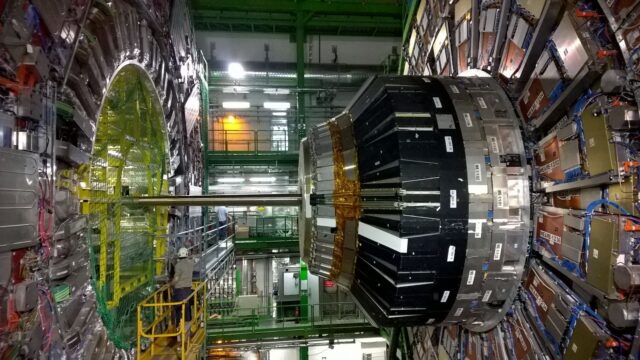
A silicon pixel detector called the Vertex Locator helped make the measurement. It sits five millimeters from the LHC beams and tracks where particles are produced and where they decay. Dr. Stefano De Capua, who directed its construction at Manchester, said nearly 90 UK companies worked on it. The wider upgrade lets the experiment gather information at up to five times its previous rate.
How sure is this?
The result sits at 3.2 sigma, below the five sigma threshold for a confirmed discovery, so more data are needed. The sources provided do not describe a journal publication. The measurement agrees with the Standard Model, the leading framework describing fundamental particles and how they interact, and the researchers have not found evidence that the theory is wrong.
Professor Conor Fitzpatrick of Manchester, deputy physics coordinator of LHCb, called the decay a golden channel for seeing effects of new physics. Professor Brian Cox, a Manchester particle physicist who was not part of the experiment, said progress could turn out to be incremental or world-changing.
The result may also help physicists probe what they call the Zeptoverse, a scale measured in zeptometers. One zeptometer is a billionth of a trillionth of a meter. Physicists suspect unknown particles and forces could show up at such scales.
What comes next
The upgraded LHCb is expected to keep collecting data into the early 2030s, which should let physicists pin down the decay rate far more precisely. Professor Chris Parkes, who led the collaboration during the upgrade, said the work was a fifteen-year project involving a 1900-member international collaboration, and that a further experiment is planned to use the High Luminosity LHC. Researchers also plan another upgrade that could raise data collection rates by a further factor of ten.
The UK collaboration includes scientists from ten universities and the STFC Rutherford Appleton Laboratory, and is funded by the Science and Technology Facilities Council.
Source: ScienceDaily
Site editor: Nikita Sheikin