Dark Energy Survey Finds Cracks in Cosmology’s Standard Model
Final Dark Energy Survey results, combined with DESI data, show a three-sigma preference for weakening dark energy. Here is what that means.
The standard model of cosmology no longer fits the full set of observations well, according to Quanta Magazine’s report on the Dark Energy Survey (DES). In May 2026 the project shared findings from its complete dataset, and combined with data from the Dark Energy Spectroscopic Instrument (DESI), they suggest the universe’s makeup is not fully understood.
“There appear to be cracks in that model,” said Simone Ferraro, a cosmologist at Lawrence Berkeley National Laboratory. Researchers cannot yet say what the missing piece is.
How a survey of hundreds of millions of galaxies works
DES began in 2003 with a handful of physicists at Fermi National Accelerator Laboratory. They built the 570-megapixel Dark Energy Camera and mounted it on the 4-meter-wide Blanco telescope in the Chilean Andes. The survey ran for 758 nights between 2013 and 2019 and grew to include more than 400 scientists across seven countries. It recorded hundreds of millions of galaxies. Researchers extended it past its planned 2018 end to make up for cloudy weather during a strong El Niño season.
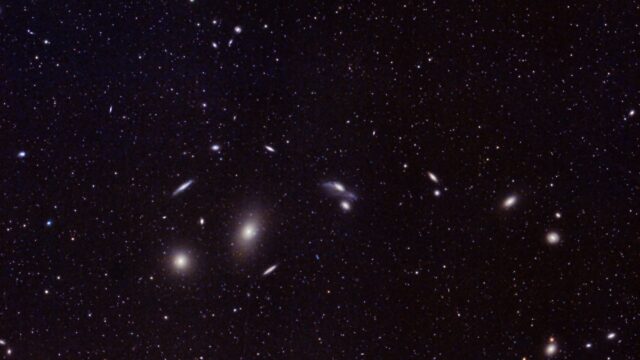
The team tracked a tug-of-war. Gravity pulls matter, mostly dark matter, together, while dark energy pushes it apart. By measuring how much matter had clumped in different eras, cosmologists can infer how strong dark energy was over time. DES did this in three ways: how tightly galaxies cluster, how foreground visible matter distorts light from background galaxies, and the same distortion mapping for foreground dark matter. It also reprocessed a catalog of 1,600 supernovas.
DESI, at Kitt Peak in Arizona, uses thousands of small movable detectors that each point at a single galaxy. It measures the size of spherical shells of slightly denser matter left by sound waves in the early universe. Those shells give distances to galaxies, and from them researchers calculate how fast the universe has grown over the past 10 billion years or so.
What the combined data show
For years DES results matched Lambda-CDM, the theory that the universe is about 30% matter and 70% dark energy, with dark energy acting like a constant property of empty space. In 2024, DESI researchers combined DES observations with a sharper image of the cosmic microwave background and their own data. Lambda-CDM no longer fit. A better fit came from dark energy that weakens over time, and a further analysis a year later found the same.
The DES final report merged its matter-clumping map, its supernova catalog, DESI’s galaxy shells and the microwave background image. The data fit somewhat better with dark energy that has slackened in recent eons. DES reports a “three-sigma” preference for that idea. That is enough to draw attention, but physicists need “five-sigma” confidence to claim a discovery.
The mismatch does not go away when one dataset is removed. Under Lambda-CDM, the microwave background picture does not quite match the matter maps, the matter maps do not quite match the supernovas, and the supernovas do not quite match the microwave background. No single dataset looks like the culprit, which makes a random artifact less likely, according to the report.
Why it matters
If dark energy changes, it would reshape the picture of how the universe will evolve. Some theorists are skeptical. They already struggle to explain why the vacuum of space has the energy it does, and a changing dark energy would add a second puzzle: why that tiny amount is fading at such a slow rate.
Other cosmologists are testing different assumptions. Lambda-CDM places the end of the hydrogen fog in the early universe at roughly 700 million years after the Big Bang. Ferraro and collaborators found in a 2025 analysis that if it happened roughly 200 million years earlier, Lambda-CDM would fit the data better.
“It’s certainly enough to make you either uncomfortable or excited,” Ferraro said.
Source: Quanta Magazine