Electrons Filmed Jumping Forbidden Energy Gaps in Graphene at 100%
Physicists filmed electrons in graphene crossing a forbidden energy gap with up to 100 percent probability. How the Nature study worked and what it leaves open.
Physicists have watched electrons in graphene leap across an energy gap they normally cannot cross, and under strong enough light fields the jump happened with a probability of 100 percent. The study, published in Nature, tracks directly how these quantum jumps, called Landau-Zener-Majorana transitions, unfold in a solid, according to Forschungszentrum Jülich.
The team came from the University of Regensburg, Philipps-Universität Marburg and Forschungszentrum Jülich. Their result gives researchers a way to study electron motion driven by light instead of by electrical voltage alone.
What a forbidden energy gap is
In semiconductors and similar materials, electrons can only hold energies within certain ranges, called energy bands. The ranges in between are forbidden gaps, where an electron has no stable state. Electrons usually stay in the band they start in.
Forschungszentrum Jülich compares the jump to riding an elevator whose display goes 1, 2, 3 and then straight to 20, skipping every floor in between. In a Landau-Zener-Majorana transition, a strong electric field pushes an electron so that it switches to another band without stopping in the gap. Physicists have long expected these transitions to matter in high-speed semiconductor electronics, but watching one happen had proved very hard.
How the team filmed the jumps
The researchers hit graphene, a sheet of carbon one atom thick, with intense pulses of light. The light’s electric field accelerated the electrons and drove some of them from one band to the next.
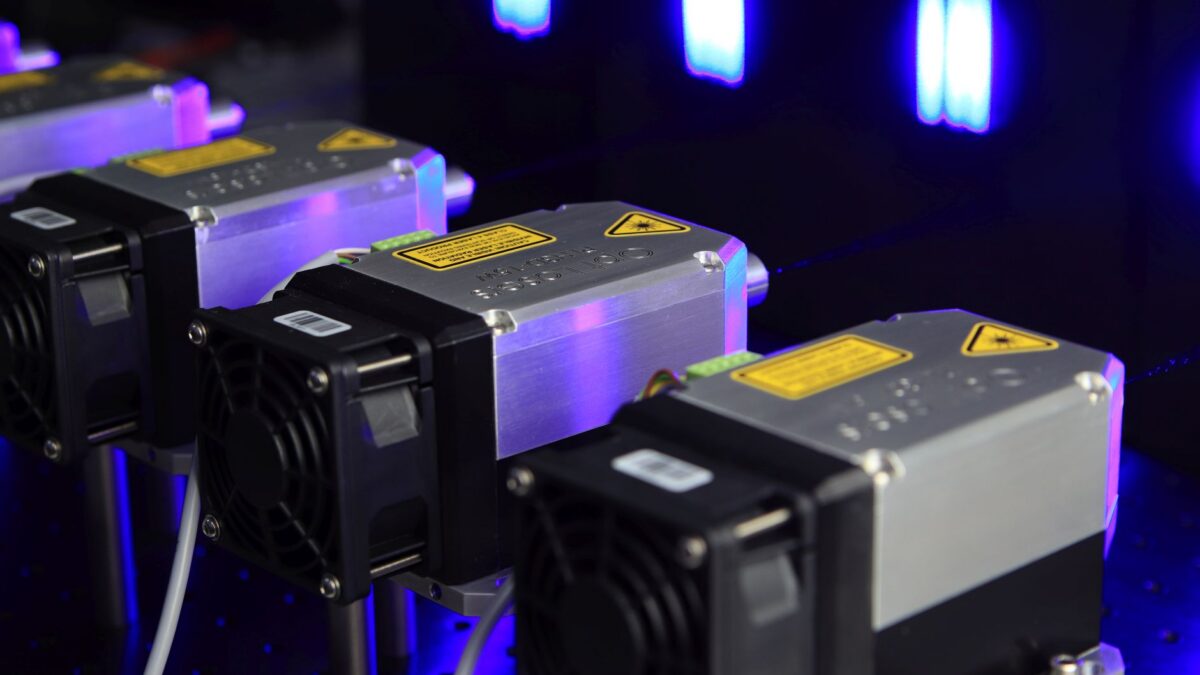
To record this, the group paired advanced lasers with a photoemission momentum microscope. This instrument does not make a magnified picture of a surface. It measures the energy of electrons and the direction they move, and the team turned those readings into maps of where electrons sit across energy states. The hard part was taking these measurements while the light field oscillated at extremely high speed, fast enough that ordinary imaging cannot follow it.
First author Vincent Eggers said the team had to observe as many electrons as possible at once to catch the few making the jump. Co-author Rupert Huber said the group worked on the experiment for many years.
The samples mattered too. Forschungszentrum Jülich made ultra-pure graphene that was nearly flawless at the atomic level, so defects would not blur the signal. Stefan Tautz of Jülich said the team also used “rotated” graphene, a Jülich specialty that lets the quantum behavior show up more clearly.
Why it matters for future electronics
The high probability is the surprising part. Electrons crossed a sizable gap almost every time, and what decided the outcome was how fast they approached the gap under the electric field. That makes the process different from ordinary quantum tunneling, where a particle passes through a barrier in physical space.
The measurements also showed a limit. The electrons start out moving in an orderly way, but interactions with graphene’s crystal lattice gradually scramble that motion. Knowing how that happens could help researchers control electrons more precisely in devices that would steer them with the rapid oscillations of light.
Those devices do not exist yet. The study is a measurement of basic physics in one carefully prepared material, and any electronics built on it remain a future possibility.
What comes next
The researchers say the technique should work on many other quantum materials. Giacomo Inzani of the University of Regensburg called the experiment “a panoramic window into the quantum world” and said the method could be used to control the electronic properties of other materials with light.
The paper, “Subcycle videography of Landau-Zener-Majorana transitions in graphene,” appears in Nature volume 659, issue 8139, page 63, with the DOI 10.1038/s41586-026-11214-y.
Source: ScienceDaily