Tiny New Red Sea Fish, Just 12 Millimeters Long, Seen Only Once
A new pygmygoby with gold-coin spots, Trimma charon, is known from two Red Sea specimens. Here is how it was found and why deeper reefs may hide more.
Scientists have described a new species of fish from the northern Red Sea that is known from just two specimens, measuring 12 and 17 millimeters long, collected during a single dive. Named Charon’s pygmygoby (Trimma charon), the translucent fish has not turned up again despite repeated searches, according to a study in the open-access journal ZooKeys.
The researchers, led by Viktor Nunes Peinemann of King Abdullah University of Science and Technology (KAUST) in Saudi Arabia, think the fish may live mainly on deeper reefs that divers rarely reach.
A fish with gold coins on its tail
The goby has a wide orange-red stripe along its see-through body and an unusual eye split into four parts. Its tail fin carries scattered golden spots. “They cover most of the fin and resemble small gold coins,” Peinemann said, as reported by SciTechDaily.
Those spots gave the species its name. In Greek mythology, Charon rowed the souls of the dead across a river into the underworld, and people were buried with a coin to pay the fare. The team sees a second link to the myth in the fish’s likely home: dim, little-studied reefs that Peinemann compared to an underworld lying below the bright, familiar shallows.
How the two specimens were found
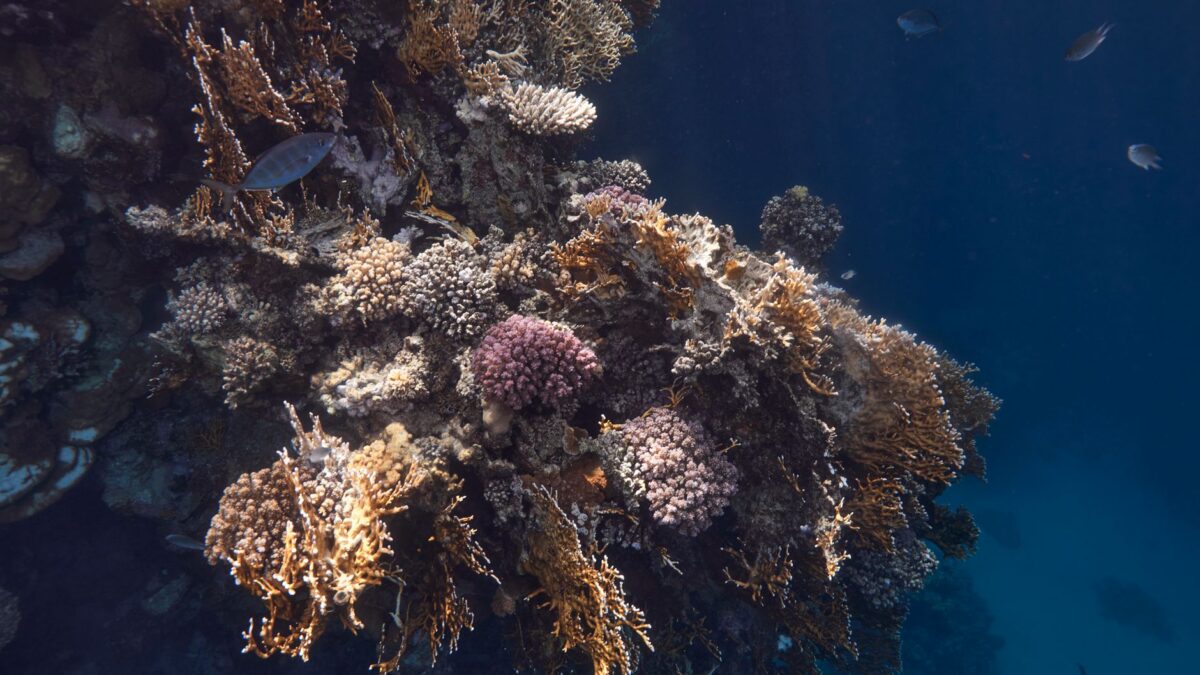
Both fish were collected in May 2023 at Walih Island, at the mouth of a cave on a steep reef slope. They sat 30 meters (about 98 feet) below the surface, the maximum depth of the team’s scientific diving. Later searches of similar spots found nothing.
That pattern led the researchers to suspect they had caught the species at the shallow fringe of its range. The fish may be more common on mesophotic reefs, the zone below 30 meters where only faint sunlight reaches. That idea is a hypothesis and has not been confirmed by any observation at those depths. “Red Sea reefs below that depth almost certainly hold more undiscovered gobies,” Peinemann said.
A cousin spread across two oceans
Trimma charon looks a lot like the pallid pygmygoby (Trimma anaima), which lives from East Africa to the Pacific but has never been recorded in the Red Sea. Genetic data point to the two being close relatives, though the authors say more work is needed to confirm it.
If the link holds, one species spread widely through the Indian and Pacific Oceans while its relative stayed in the Red Sea and evolved on its own for millions of years, Peinemann said.
Why it matters for Red Sea reefs
The new fish raises the count of known Trimma species in the Red Sea to 11, the most of any goby genus in the region. At least nine of them appear to be found nowhere else on Earth. Because these fish are small and easy to confuse, the paper includes an illustrated guide for telling all 11 apart, with photographs and field notes on where each one lives.
Peinemann said that knowing which species are present, how to identify them and where they live is the first step toward understanding these reef ecosystems.
Who did the study
The paper, titled “Trimma charon, a new species of pygmygoby (Teleostei, Gobiidae) from the Red Sea with a key to the Red Sea species of the genus,” was published Sept. 24, 2026. Peinemann works in KAUST’s Marine Science Program. His co-authors are Matthew D. Tietbohl Talas and Michael L. Berumen of KAUST and Sergey V. Bogorodsky of the Senckenberg Research Institute and Natural History Museum Frankfurt in Germany. The DOI is 10.3897/zookeys.1293.204097.
Source: SciTechDaily
Site editor: Nikita Sheikin