Voyager 1 Reaches One Light-Day From Earth, 16 Billion Miles Out
NASA's Voyager 1 is about to sit one light-day from Earth, roughly 16 billion miles away. What the milestone means and how NASA is marking it.
NASA’s Voyager 1 spacecraft reaches one light-day from Earth on Wednesday, according to Space.com. That is the distance light covers in a day, about 16 billion miles (26 billion kilometers), and no other object built by people has gone that far.
At that range, a radio command sent from Earth at the speed of light needs roughly 24 hours to arrive.
How far Voyager 1 has come since 1977
Voyager 1 launched on Sept. 5, 1977, and has been traveling for nearly 50 years. It is now the most distant human-made object from Earth and is still collecting scientific observations in interstellar space. NASA talks to it through the Deep Space Network, its system of large radio dishes.
Its twin, Voyager 2, followed a different path through the solar system and is expected to hit the same one-light-day mark in November 2035, Space.com reported.
A light signal the probe will never see
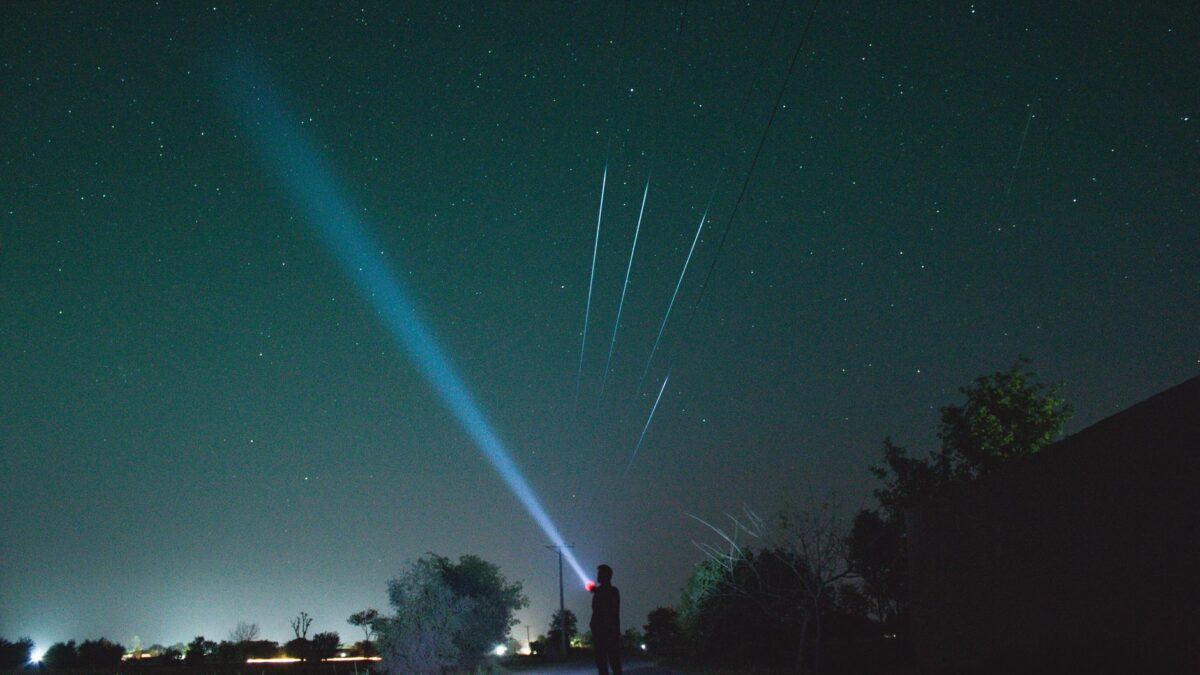
NASA has asked people around the world to mark the milestone with an event called “Shine Bright for Voyager’s Light-Day,” held after sunset on Tuesday, Nov. 17, the day before the spacecraft crosses the line. Participants point a flashlight, phone, bike light or other portable light at the sky and flash VGR, the mission’s three-letter call sign, in Morse code. The agency describes the goal as a symbolic wave of golden light around the planet.
The pattern, as NASA described it:
- V: three quick flashes, then one long flash
- G: two long flashes, then one quick flash
- R: one quick flash, one long flash, one quick flash
NASA suggests repeating the sequence for about a minute. For anyone who does not know Morse code, the agency built an automated flasher that runs in a phone or tablet browser. People can photograph or film their signals and share them on social media by tagging @NASA.
The gesture is a tribute only. Light from a phone cannot reach a probe 16 billion miles away, and NASA makes no attempt to use it as a message.
What this means for the mission
Every command to Voyager 1 now takes about a day to arrive, and engineers have to keep probes that are nearly 50 years old working at that distance. NASA lists those engineering problems among the topics it will discuss this week. The light-day mark also gives a simple picture of the scale: light itself needs 24 hours to cross the gap between Earth and the spacecraft.
What happens next
On Thursday, Nov. 19, at 12 p.m. EST (1700 GMT), NASA’s Jet Propulsion Laboratory in Southern California will host a moderated discussion with Voyager team members and NASA leadership. They plan to cover the current state of both spacecraft, the observations they still collect in interstellar space and the work of keeping them running, followed by questions from media and the public.
NASA will also preview a Voyager documentary planned for release in 2027, the year of the mission’s 50th anniversary.
Source: Space.com