Which Planets Are Visible Tonight? How to Find and Identify Them
Planets move through the sky from month to month, so the answer changes. Here is how to work out what is up tonight and how to tell a planet from a bright star.
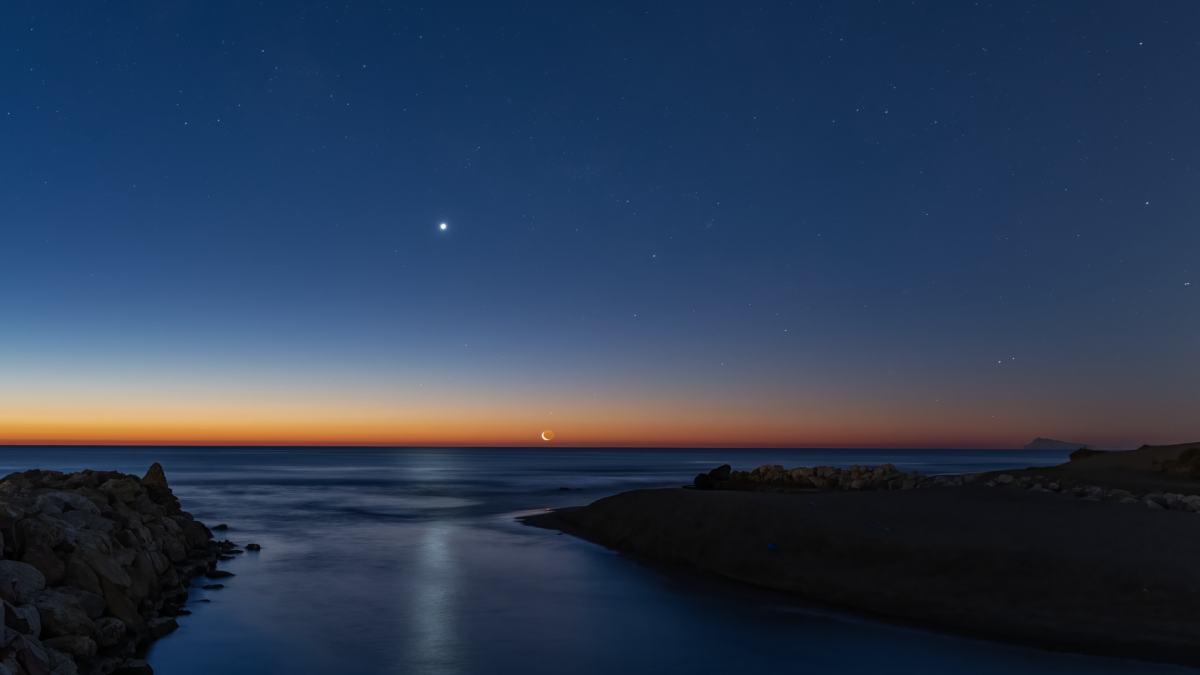
Five planets can be seen with the naked eye: Mercury, Venus, Mars, Jupiter and Saturn. Which of them are up tonight depends on where each one sits in its orbit, so the list changes every few weeks. In November 2026, NASA’s monthly skywatching guide points to Mars and Jupiter together in the southeast before dawn, with Venus low in the east.
The quickest way to check for any night is NASA’s monthly What’s Up guide or a free planetarium app. The rest of this guide explains what to look for once you are outside.
How do you find out which planets are up tonight?
Check a current sky guide, then look at the right time and direction. Planets do not keep fixed places among the stars, so last year’s chart is no help.
- Open NASA’s What’s Up guide for the current month. It names the planets worth seeing, the direction and whether to look after sunset or before sunrise.
- Note whether each planet is an evening or a morning object. Evening planets sit in the west or south after sunset; morning planets appear in the east or south before dawn.
- Go out 30 to 60 minutes after sunset, or before sunrise, and find a view low to the horizon in the right direction.
- Look for points that are bright and steady. A planetarium app pointed at the sky will confirm what you are seeing.
For example, NASA’s November 2026 guide says Mars and Jupiter appear 1.2 degrees apart in the southeast on the mornings of Nov. 15 and 16. Jupiter is the brighter of the pair, with reddish Mars beside it, and both are easy to see with no optical aid.
Why are some planets only visible in the morning or evening?
A planet is visible only when it sits far enough from the Sun in our sky to stand out against a dark background. As planets and Earth move along their orbits, each one drifts from the evening sky to the morning sky and back.
- Mercury and Venus orbit inside Earth’s orbit, so they never stray far from the Sun. You only see them in twilight, low in the west after sunset or low in the east before sunrise.
- Mars, Jupiter and Saturn orbit outside Earth’s. When Earth passes between one of them and the Sun, that planet rises at sunset and stays up all night. This is the best time to see it.
- When an outer planet sits behind the Sun from our point of view, it is lost in the glare for weeks.
Mercury is the hardest of the five. It is best seen for a week or two at a time, low in bright twilight, so a clear, flat horizon helps.
How can you tell a planet from a star?
Planets usually shine with a steadier light than stars, follow the same narrow path across the sky and shift position against the stars from night to night. Bright stars near the horizon twinkle and flash colors; planets near the horizon twinkle much less.
| Planet | What it looks like | What you need |
|---|---|---|
| Venus | The brightest point in the sky after the Moon, white and steady, always near dawn or dusk | Naked eye |
| Jupiter | Very bright, creamy white; binoculars show up to four small moons in a line | Naked eye; binoculars for moons |
| Mars | Orange to red; brightness changes a lot from year to year | Naked eye |
| Saturn | Yellowish and steady, fainter than Jupiter; a small telescope shows the rings | Naked eye; telescope for rings |
| Mercury | Small, pinkish point low in twilight, close to the horizon | Naked eye, clear horizon |
| Uranus, Neptune | Not visible to the naked eye | Binoculars or telescope plus a chart |
Another clue is the line the planets follow. All of them stay close to the ecliptic, the path the Sun and Moon also take across the sky. A bright point far from that line, such as near the North Star, is not a planet.
A bright point that moves steadily across the sky in a few minutes is not a planet either. It is most likely the space station or a satellite; see our guides on how to see the ISS and how to spot Starlink satellites.
What is a planet parade?
A planet parade is an informal name for a time when several planets are visible in the same part of the sky at once. NASA says “planet parade” is not a technical term in astronomy, and the planets are not actually lined up in space.
The planets look like they form a line because they all orbit the Sun in nearly the same flat plane. From Earth, we see that plane edge-on as the ecliptic. NASA says lineups of four or five naked-eye planets with good visibility happen every few years.
Be careful with headlines about six- or seven-planet parades. NASA points out that Uranus and Neptune are never visible to the unaided eye, and planets sitting low in twilight are much harder to see than a diagram suggests. NASA’s page on planetary alignments and planet parades explains how these events work.
Do you need a telescope to see planets?
You do not need a telescope to see the five bright planets. A telescope or steady binoculars add detail: Jupiter’s moons, Saturn’s rings and the phases of Venus.
- Binoculars on a steady support show Jupiter’s moons as tiny points of light beside the planet.
- A small telescope at around 50x magnification shows Saturn’s rings.
- Venus shows a crescent or half phase in a telescope, much like the Moon.
- Never point binoculars or a telescope near the Sun. Wait until it has fully set before looking for Mercury or Venus in the west.
Light pollution matters less for planets than for faint objects. Bright planets show up even from a city, which makes them a good first target. If you are out on a night with a meteor shower, our meteor shower calendar lists peak dates.
Bottom line
Mercury, Venus, Mars, Jupiter and Saturn are visible without a telescope, but not all at once and not every night. Check NASA’s What’s Up guide for the current month, look low in the west after sunset or in the east before dawn, and pick out the bright, steady points along the ecliptic. In November 2026, Mars and Jupiter pair up in the predawn southeast.
FAQ
What is the bright star near the Moon tonight?
It is often a planet, because the Moon travels along the same path through the sky as the planets. Venus and Jupiter are the most likely if the point is very bright and does not twinkle.
Can you see planets from a city?
Yes. Venus, Jupiter, Mars and Saturn are bright enough to show through city lights. Mercury is harder because it stays low in twilight.
Which planet is red in the night sky?
Mars has an orange-red color that stands out from white stars. Some bright stars, such as Antares and Betelgeuse, also look reddish, so check a chart if you are unsure.
How often do planets line up?
NASA says sightings of four or five naked-eye planets in the sky at once happen every few years. Smaller groupings of two or three planets are much more common.