Comet 220P Brightened 250 Times in Half a Day as Gas Tore Its Crust
Comet 220P/McNaught flared 250 times brighter in half a day this summer when escaping gas blew off its crust. What the study found and why it matters.
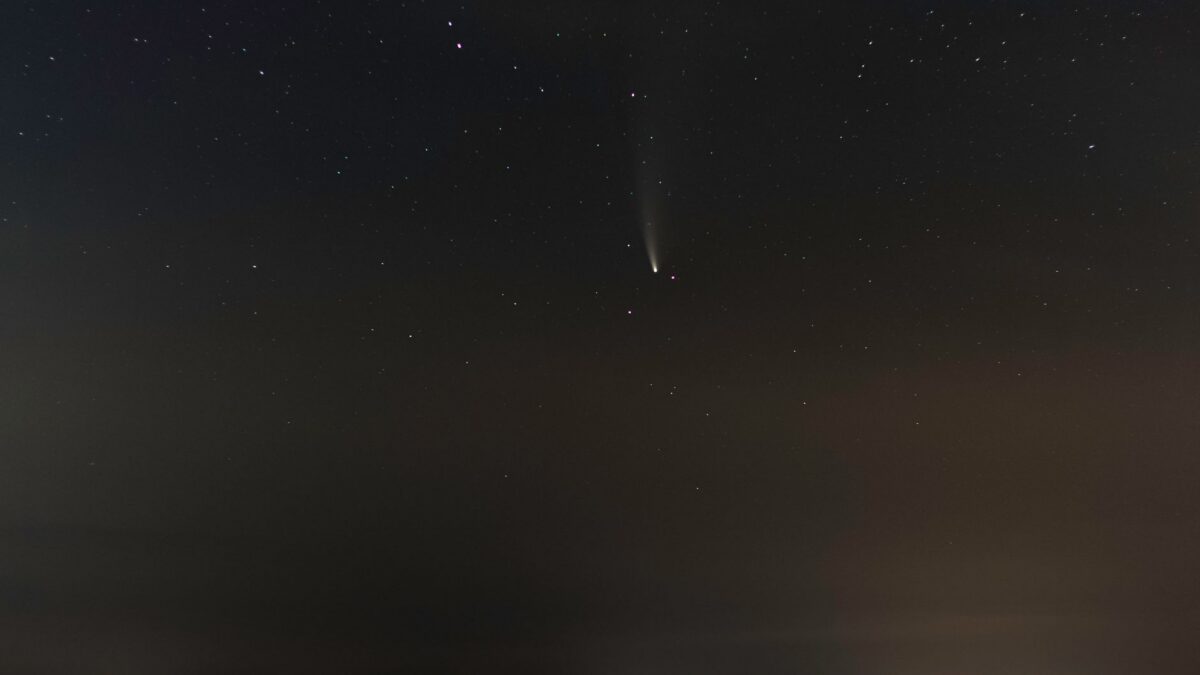
A faint comet called 220P/McNaught grew 250 times brighter in half a day this summer after gas building up under its crust burst out and threw a huge cloud of dust into space. The result, published Nov. 3 in the Monthly Notices of the Royal Astronomical Society, was reported by Space.com.
The comet then did it again. A second outburst at the end of July lifted it from magnitude +14 on July 28 to magnitude 6.1 by Aug. 6, a level within reach of binoculars.
A dim comet that suddenly woke up
Australian astronomer Robert McNaught found the comet in 2004. It returns about every five-and-a-half years and at its closest gets roughly as near the sun as Mars. Most of the time it sits fainter than magnitude +15, too dim for most amateur telescopes. On the magnitude scale, a higher number means a fainter object.
The dates in the report differ slightly. It says the comet flared on June 14 on its way toward perihelion (its closest point to the sun, 1.5 astronomical units out), but its brightness log starts the jump earlier. On May 31 the comet stood at magnitude +17.39. In less than 14 hours it reached +11.05, bright enough for small backyard telescopes. By June 2 it had climbed to +8.23 and could be picked out briefly in 10×50 binoculars from a dark site, and amateur astronomers rushed to photograph it.
It had dimmed to about magnitude +12 by perihelion, a few weeks before the second, larger outburst began.
How a dirty snowball blows its top
Comets carry ices of water, carbon dioxide and nitrogen beneath a dusty crust. Sunlight, even at the distance of Mars, can turn those ices straight into gas, a process called sublimation. Pressure from the escaping gas then rips open the surface.
The team built models from observations of the outburst. They estimate that 220P released somewhere between tens of billions and hundreds of billions of pounds of dust. The grains were only millionths of a meter across and spread outward at about 1,280 feet (390 meters) per second. They filled the coma, the thin cloud of gas and dust around the solid nucleus, and scattered sunlight, so the comet looked far brighter from Earth.
“The comet detached localized parts of its crust,” said Josep M. Trigo-Rodríguez of the Institut de Ciències de l’Espai and the Institute of Space Studies of Catalonia in Spain. He said the dust-rich cloud raised the brightness 250 times in half a day.
This is the first outburst ever seen from 220P. Other comets have flared without warning before. In the fall of 2007, comet 17P/Holmes brightened a million-fold, rising from magnitude +17 to +2.8 and becoming a naked-eye object in Perseus.
Why it matters for comets that could hit Earth
With its 5.5-year orbit, 220P belongs to the Jupiter-family comets. According to Trigo-Rodríguez, these come mostly from the Kuiper Belt and the Scattered Disk beyond Neptune and drift inward until Jupiter’s gravity locks them into short orbits. Watching one break apart gives researchers a rough measure of how strong such bodies are inside.
That strength is what his group cares about most. The researchers study impact hazards, and Trigo-Rodríguez said some comets look fragile enough that methods for deflecting or disrupting them might differ a lot from those tested or proposed for asteroids. The work so far comes from one comet and from models fitted to its outbursts, so it shows what 220P did rather than how all comets behave.
What happens next
The comet passed closest to Earth on Oct. 12, at 1.04 astronomical units or 97 million miles (156 million kilometres). It is now around magnitude +13 and fading as it heads toward the far end of its orbit, just inside Jupiter’s path at 4.68 astronomical units, or 435 million miles (700 million kilometers). Astronomers will watch it again when it returns in late 2031. Readers hoping to catch a future flare can start with our guide on what a comet looks like in the sky and how to find one.
Source: Space.com