Solar Eclipse in Madrid and Barcelona on Aug. 2: Times and Coverage
Madrid sees a partial eclipse peak at 10:51 and Barcelona at 10:58 local time on Aug. 2, 2027. Coverage, timings and where totality starts.
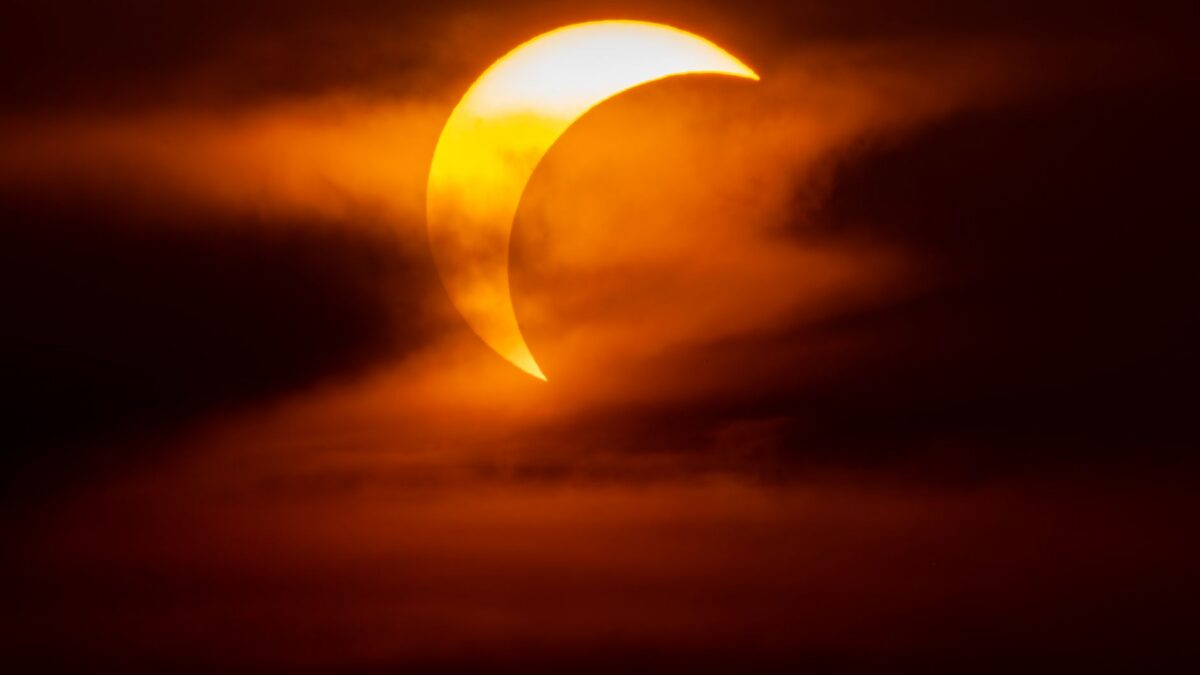
Madrid and Barcelona both get a deep partial solar eclipse on the morning of Monday, Aug. 2, 2027, and neither city sees totality. In Madrid the eclipse runs from 09:45 to 12:02 local time and peaks at 10:51 with a magnitude of 0.880. In Barcelona it runs from 09:50 to 12:11 and peaks at 10:58 with a magnitude of 0.843. The Moon’s full shadow crosses the far south of Spain, where Málaga has 1 minute, 57 seconds of totality.
What time is the eclipse in Madrid?
In Madrid the partial eclipse begins at 09:45, reaches maximum at 10:51 and ends at 12:02, all in local time, according to the timeanddate page for Madrid. From first contact to last, the event lasts 2 hours, 17 minutes.
The page classes the event as a partial solar eclipse for Madrid, even though it is a total solar eclipse on the global scale. The Moon never fully covers the Sun as seen from the capital.
What time is the eclipse in Barcelona?
Barcelona’s eclipse starts at 09:50, peaks at 10:58 and ends at 12:11 local time, a total of 2 hours, 20 minutes, according to the timeanddate page for Barcelona. Each stage comes a few minutes later than in Madrid.
Barcelona is farther from the path of totality than Madrid, so the Moon covers a little less of the Sun there.
How much of the Sun is covered in each city?
At maximum, the eclipse magnitude is 0.880 in Madrid and 0.843 in Barcelona. Magnitude is the fraction of the Sun’s diameter that the Moon hides. It is a different measure from the share of the Sun’s area that is blocked, so the two figures should not be read as percentages of the disk.
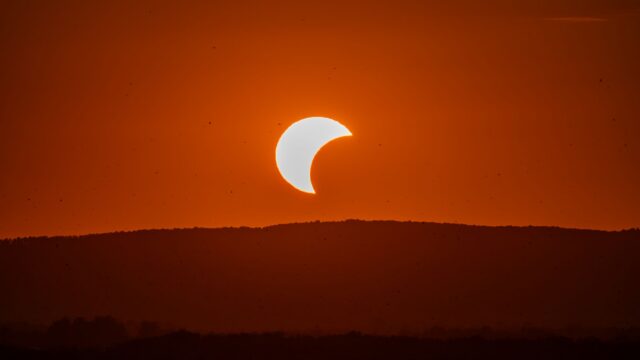
At those magnitudes the Sun shrinks to a thick crescent at the peak. Daylight dims noticeably, but the sky does not go dark and the Sun’s corona stays invisible. A partial eclipse is never safe to look at with the naked eye, at any stage. Eclipse glasses made for solar viewing, or an indirect method such as a pinhole projector, are needed from start to finish.
Where is the nearest place with totality?
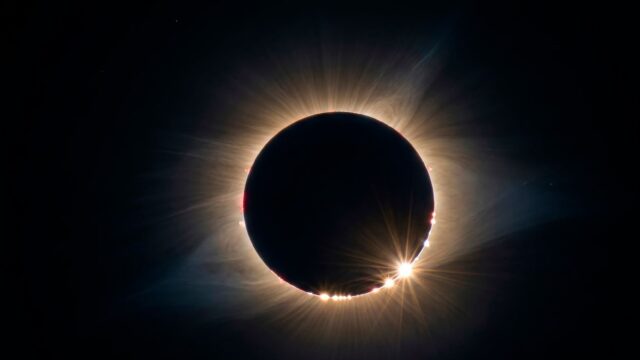
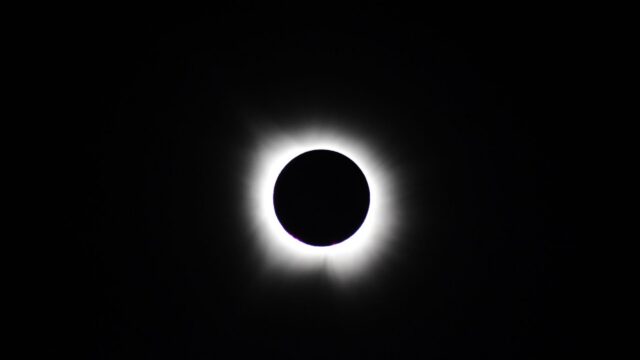
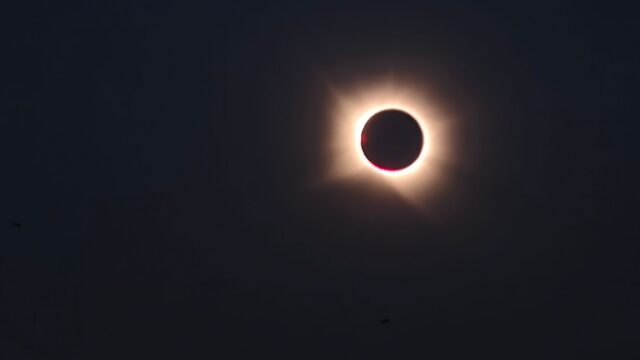
The closest totality to both cities is on Spain’s southern coast. Málaga is inside the path: the partial phase there begins at 09:42, the maximum comes at 10:49 with a magnitude of 1.003, and the eclipse ends at 12:02, according to the timeanddate page for Málaga. Totality in Málaga lasts 1 minute, 57 seconds. A magnitude above 1 means the Moon appears slightly larger than the Sun and covers it completely.
Málaga sits near the northern edge of the path, which is why its totality is short. NASA’s path table for the eclipse lists the limits of the Moon’s umbral shadow at 120-second intervals. At 08:50 Universal Time the northern limit is at latitude 36 48.9N, longitude 003 38.2W, while the central line runs farther south at latitude 35 44.6N, where the table gives a duration of 04m59.1s. Totality gets longer the closer an observer is to that central line, so the longest views in the region are south of the Spanish mainland.
We have separate local timings for the southern coast in our guide to the eclipse in Cádiz, Málaga and Marbella, and a wider look at the full path of the Aug. 2, 2027 total eclipse.
Which countries see a total eclipse that day?
The timeanddate overview of the eclipse lists a total solar eclipse for Spain, Gibraltar, Morocco, Algeria, Tunisia, Libya, Egypt, Sudan, Saudi Arabia, Yemen and Somalia, along with the British Indian Ocean Territory. For Spain as a whole, the eclipse starts at 08:32 WEST and ends at 12:15 CEST. Gibraltar’s runs from 09:41 to 12:01 CEST.
Much of the rest of Europe sees a partial eclipse. Andorra’s lasts from 09:51 to 12:09 CEST and France’s from 09:49 to 12:22 CEST. Those country figures give the earliest start and latest end anywhere inside the borders, so a single town sees a shorter event.
On the global clock, the first location sees the partial eclipse begin at 07:30:11 UTC and the first location enters totality at 08:23:29 UTC. Maximum eclipse comes at 10:06:40 UTC. The last location leaves totality at 11:49:54 UTC, and the partial eclipse ends everywhere at 12:43:10 UTC. Timeanddate says eclipse calculations are usually accurate to a few seconds.
What should viewers in Madrid and Barcelona plan for?
The whole event happens in mid-morning in both cities, so any spot with an open view of the Sun works, including a balcony or a park. The numbers to keep handy are the three local times for each city:
- Madrid: begins 09:45, maximum 10:51, ends 12:02.
- Barcelona: begins 09:50, maximum 10:58, ends 12:11.
Whether the eclipse is visible on the day depends on the weather, and clouds at the wrong moment can hide the peak. Anyone who wants totality has to travel into the path. Even the 0.880 magnitude in Madrid leaves a bright sliver of Sun that needs eye protection the entire time.
Quick answers
Is the Aug. 2, 2027 eclipse total in Madrid or Barcelona?
No. Both cities see a partial solar eclipse. The maximum magnitude is 0.880 in Madrid and 0.843 in Barcelona.
How long does totality last in Málaga?
Totality in Málaga lasts 1 minute, 57 seconds, with the maximum at 10:49 local time.
When is the next solar eclipse visible from Madrid and Barcelona?
Timeanddate lists the next one on Jan. 26, 2028. It is an annular solar eclipse worldwide and appears as a partial solar eclipse from Madrid. The Barcelona page lists it as annular.
When is the next total solar eclipse anywhere in the world?
The next total solar eclipse after this one is on July 22, 2028, according to timeanddate.
Checked against official sources in November 2026. Hours, prices and rules change: confirm on the official page before you go or apply.