One-Hour Flicker of a Star Points to Moon-Mass Black Hole Candidate
A one-hour brightening of a star in the Large Magellanic Cloud may come from a primordial black hole about three Moon masses. The study is an arXiv preprint.
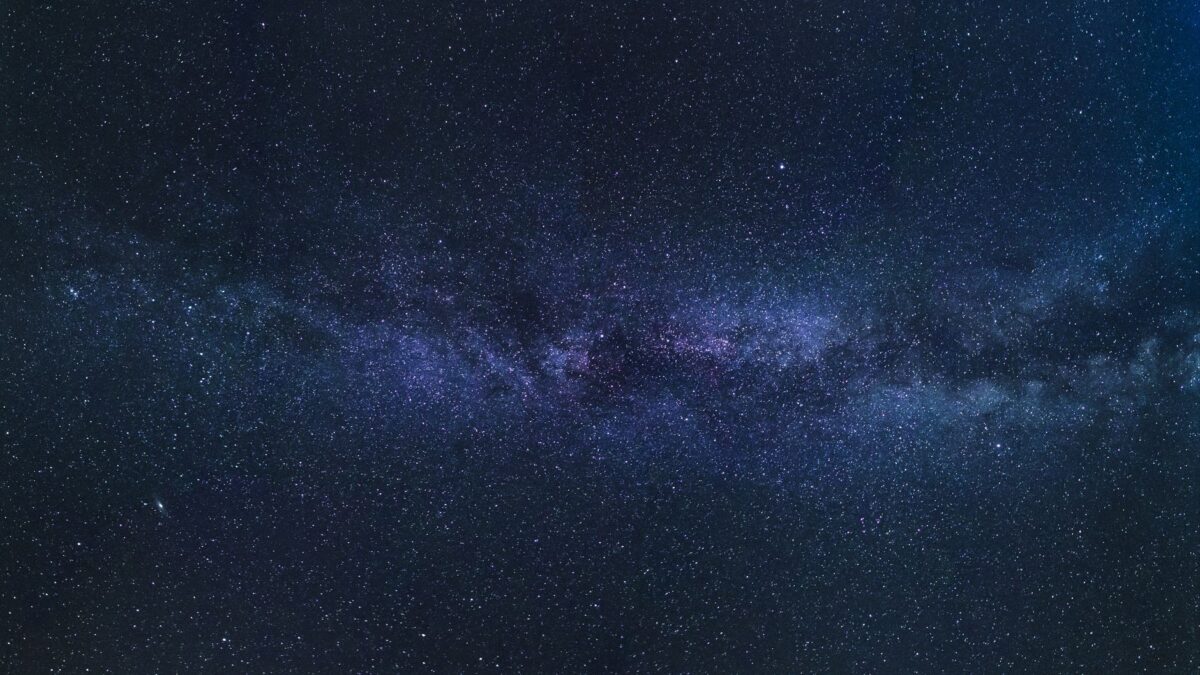
An object nicknamed Phoebe, with an estimated mass of about three times that of the Moon, briefly magnified a star in the Large Magellanic Cloud for roughly 60 minutes on Dec. 18, 2019. One of three explanations the researchers consider is that it is a primordial black hole, a type of black hole thought to have formed in the first fractions of a second after the Big Bang, long before the first stars.
The finding was reported by Universe Today and republished by ScienceDaily. It comes from a paper posted on the arXiv preprint server on May 19, 2026, which is a draft shared publicly and not a peer-reviewed journal article.
How the signal was found
The Large Magellanic Cloud is a small satellite galaxy of the Milky Way. Astronomers at Swinburne University in Melbourne were examining data from a survey that frequently monitors stars there. They found a star that grew steadily brighter for about an hour and then faded back to normal. The change was smooth and symmetrical, with no explosion or flare, and the star showed no further changes afterward.
That pattern matches gravitational microlensing, an effect predicted by Einstein’s general theory of relativity. When a compact object passes in front of a distant star, its gravity bends the star’s light toward Earth and temporarily makes the star look brighter. The shape of the brightening differs from what variable stars, stellar flares or passing asteroids produce.
Lighter lenses tend to give shorter events, although the object’s speed and position also affect the duration. Using the roughly 60-minute length and their models, the team estimated the mass at about three times the Moon’s. The signal sits near the detection limit of current surveys.
Three candidates for Phoebe
The researchers list three possibilities. Phoebe could be a rogue planet, one thrown out of its home solar system and drifting alone through the Milky Way. It could be a similar wandering planet inside the Large Magellanic Cloud, which would make it the first planet found by microlensing beyond our galaxy. Or it could be a primordial black hole.
Black holes formed from collapsing stars typically have masses of at least about five times that of the Sun, according to the report. Phoebe’s estimated mass is far below that, so a black hole identity would point to a primordial origin. Primordial black holes would have emerged from extremely dense regions of the early universe.
The team also compared how likely it is that the object belongs to different populations: Milky Way stars, stars of the Large Magellanic Cloud, or the surrounding dark matter halo, the large invisible cloud of dark matter around a galaxy. By their calculations, Phoebe is approximately 100,000 times more likely to belong to the halo population than to one tied to ordinary stellar matter. The report notes this does not establish that Phoebe is a primordial black hole.
How sure is this?
Not very, by the authors’ own framing: the paper’s title calls Phoebe a “candidate.” The work is a preprint by Renee Key, Edward N. Taylor, Ken C. Freeman, Jeremy Mould, Abhijit Saha, Anais Möller, Timothy M. C. Abbott and Alan R. Duffy (DOI: 10.48550/arXiv.2605.19375), and it has not been confirmed as peer-reviewed. It rests on a single event. The mass is an estimate from the signal’s duration and the team’s models, and a rogue planet in either location remains possible. The lens itself was never seen, so its identity is inferred only from how it bent light.
If Phoebe is a primordial black hole, it would be one of the oldest objects ever detected, possibly about 13 billion years old, and it could bear on the question of what dark matter is. The sources do not describe planned follow-up observations.
For background on the objects involved, see how black holes form and what the first images show.
Source: ScienceDaily
Site editor: Nikita Sheikin