Comet Hartley-IRAS Reaches Perihelion With a Green Glowing Nucleus
Comet 161P/Hartley-IRAS reaches perihelion on Nov. 26 and shows a green nucleus in a small scope. Here is where to look in the evening sky.
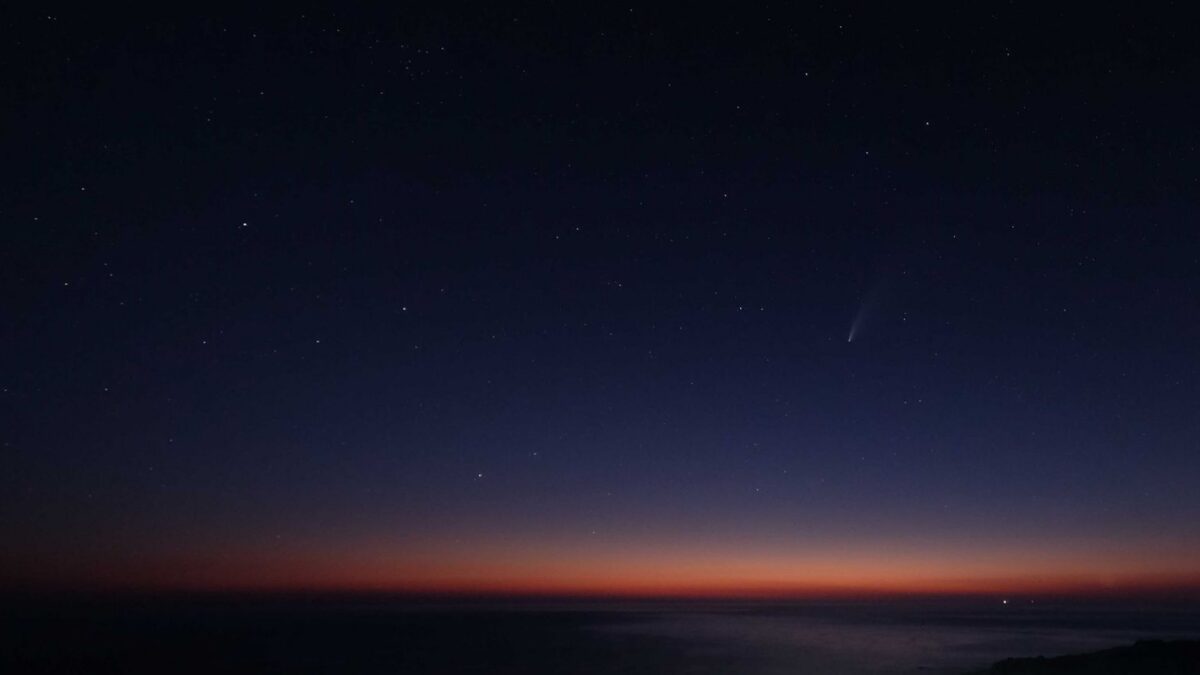
Comet 161P/Hartley-IRAS reaches perihelion, its closest point to the Sun, on Nov. 26, according to Astronomy magazine. The comet circles the Sun once every 21½ years, and its nucleus has been showing a green glow in recent astrophotos.
The comet has held a fairly steady brightness of 10th to 11th magnitude (on the astronomical scale, higher numbers are fainter). It has no appreciable tail. Astronomy says that a 4-inch telescope is enough to see it.
Where to find the comet
Astronomy’s Sky Today column says the Moon-free window for observing the comet reopens on the evening of Nov. 26. Moonrise from 40° N 90° W is at 7:53 p.m. local time, and the Moon is a waning gibbous, 82% illuminated at 10 p.m. from that location.
The comet sits in the west a few hours after sunset. Around 7 p.m. local time it is still 30° above the horizon, which keeps it out of the turbulent air near the ground that blurs astronomical views. It lies in the western part of the constellation Sagitta, about 6.3° north-northeast of Zeta (ζ) Aquilae, a 3rd-magnitude star.
Larger telescopes show more detail around the nucleus, the solid core of the comet. Astronomy suggests looking for a sharpened southern flank, which would form as the comet moves into the solar wind, the stream of charged particles flowing from the Sun. Readers new to comet watching can find general tips in this guide on what a comet looks like in the sky.
A second target nearby
About 2.1° northeast of the comet is the Coathanger asterism in the constellation Vulpecula. An asterism is a recognizable pattern of stars that is not itself a constellation. The Coathanger is 1° long and resembles its namesake, with the hook on the southern side of the hanger’s arms.
How the column describes the observations
The positions and brightness come from Astronomy magazine’s daily sky column, written by senior editor Alison Klesman. The green glow of the nucleus is drawn from recent astrophotos, which are long-exposure photographs taken through telescopes. The column gives times in local time for 40° N 90° W: sunrise at 6:59 a.m., sunset at 4:36 p.m., and moonset at 10:26 a.m.
How sure is this?
This is a viewing guide from a magazine column, not a peer-reviewed study. The brightness figure is a range, and comet brightness can change, so what you see may differ from the column’s description. The source does not give an exact time for perihelion. The column’s headline carries the date Nov. 27, while the entry for the comet is dated Nov. 26, so check the date against a current ephemeris (a table of the comet’s predicted positions) before heading out.
Visibility depends on your location and the weather. The sky positions above apply to the viewing time and place the column used, so the comet will sit at a different height and angle from other locations and at other times of night. Because the comet is faint and has no tail, a dark site away from city lights will help, and binoculars or the naked eye are not mentioned as options in the source.
Source: Astronomy Magazine
Site editor: Nikita Sheikin