When Did the First People Reach the Americas? What Sites Show
For decades the textbook answer was about 13,000 years ago. Footprints pressed into an ancient lakeshore in New Mexico have pushed that back by roughly 8,000 years.
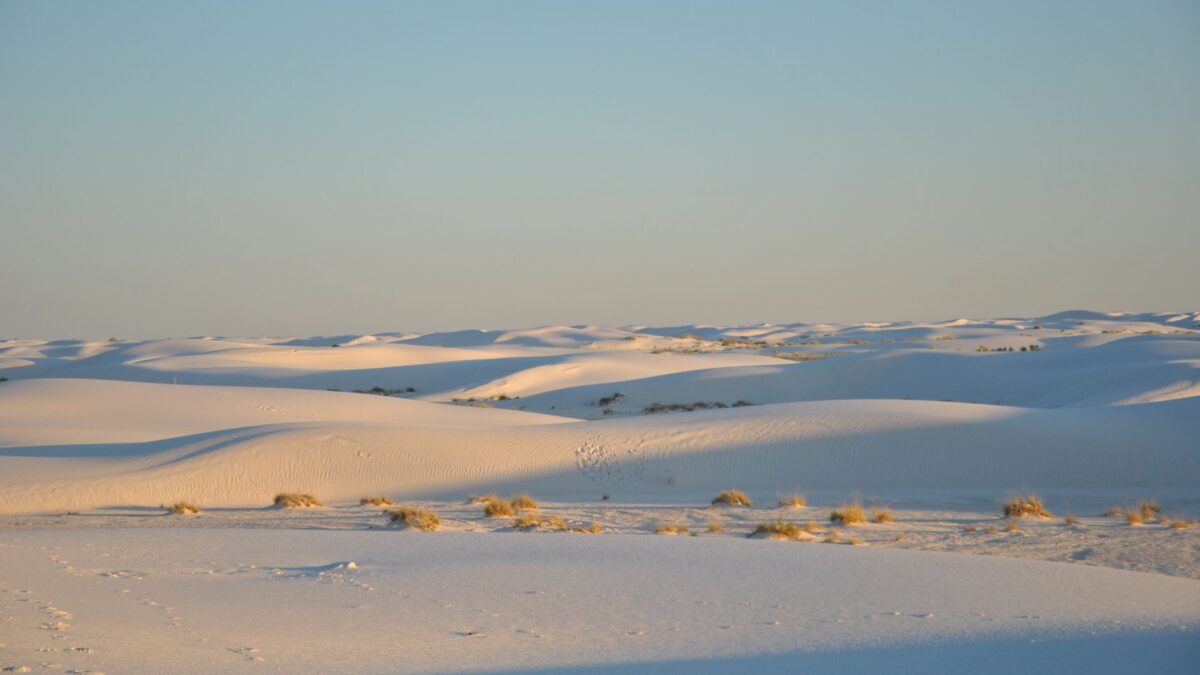
People reached the Americas at least 21,000 to 23,000 years ago, according to human footprints at White Sands National Park in New Mexico, dated in 2021 and confirmed by two independent methods in 2023. That is roughly 8,000 years earlier than the Clovis culture, which archaeologists long treated as the first Americans, about 13,000 years ago.
How those first people arrived, by land across Beringia or by boat along the Pacific coast, is still debated, and some researchers still question the White Sands dates.
What was the Clovis-first idea?
For most of the 20th century, many archaeologists thought the Clovis people were the first to settle the Americas. Clovis sites, named after Clovis, New Mexico, are known for large, finely made stone spear points, sometimes found with mammoth bones.
A 2007 study in Science by Michael Waters and Thomas Stafford re-examined the Clovis dates and narrowed them to 11,050 to 10,800 radiocarbon years before present, which corresponds to roughly 13,000 calendar years ago. The authors noted that this short span overlaps with non-Clovis sites in North and South America and concluded that people were already living in the Americas before Clovis.
Radiocarbon years are not calendar years; they have to be calibrated against tree rings and other records. Our explainer on how carbon dating works covers why.
Which sites are older than Clovis?
Several sites now point to people in the Americas well before 13,000 years ago. These are among the most cited:
| Site | Location | Reported age | Evidence |
|---|---|---|---|
| White Sands | New Mexico, USA | About 21,000 to 23,000 years | Human footprints in lakeshore layers (Science, 2021 and 2023) |
| Cooper’s Ferry | Idaho, USA | About 16,000 years | Stone tools and hearths (Science, 2019) |
| Monte Verde II | Southern Chile | About 14,000 years | Camp remains, including seaweed dated to 14,220 to 13,980 years ago (Science, 2008) |
| Clovis sites | Across North America | About 13,000 years | Distinctive spear points, sometimes with mammoth bones |
Monte Verde, excavated by Tom Dillehay and colleagues, was a turning point. It sits near the southern tip of South America, so people had to have entered the continents well before they reached Chile. A 2015 paper by the same team reported possible traces of human activity there from about 18,500 to 14,500 years ago, which remain less widely accepted than the main site.
How were the White Sands footprints dated?
The White Sands footprints were first dated from seeds of an aquatic plant, Ruppia, found in layers above and below the prints. A 2021 study in Science reported that they were made between about 23,000 and 21,000 years ago, during the Last Glacial Maximum, the coldest part of the last ice age.
Critics pointed out that water plants can take up old carbon dissolved in lake water, which would make them look older than they are. So a USGS-led team tested the dates two other ways, published in Science in 2023:
- They radiocarbon dated conifer pollen from the same layers. Pollen comes from land plants that take carbon from the air, so it avoids the old-carbon problem. The pollen ages matched the seed ages.
- They used optically stimulated luminescence on quartz grains, which shows when the grains were last exposed to sunlight. The footprint layers gave a minimum age of about 21,500 years.
The USGS release described three separate lines of evidence pointing to the same age range. Not everyone is persuaded: a 2024 paper by another group argued that the dates could still be affected by old carbon and reworked pollen. The 2021 paper also noted that the people who made the prints lived alongside ice-age megafauna.
How did people get to the Americas?
The first Americans came from northeast Asia, and the two main routes debated are an inland path and a coastal one. During the ice age, so much water was locked in ice sheets that sea level was far lower, exposing a land bridge between Siberia and Alaska known as Beringia.
- Inland route: people walked from Beringia south through a gap between the two great North American ice sheets. Many researchers think that corridor was blocked by ice during the Last Glacial Maximum, which makes it hard to explain people in New Mexico 23,000 years ago.
- Pacific coast route: people moved along the coast, perhaps by boat, living off marine resources. The seaweed at Monte Verde, brought from distant beaches according to the 2008 Science study, fits a population at home on the coast.
Coastal sites from that time would now be underwater, because sea level has risen by tens of meters since the ice melted. That makes the coastal route hard to prove or rule out.
What is still debated?
Archaeologists broadly agree that people were in the Americas before Clovis. They still disagree on how much earlier:
- whether the White Sands dates of 21,000 to 23,000 years will hold up against new tests;
- whether a few very early people left no descendants, or founded the populations that followed;
- which route came first and whether both were used.
The people who arrived met ice-age animals such as mammoths, mastodons and giant ground sloths. We look at what happened to them in why woolly mammoths went extinct.
Bottom line
The Clovis-first idea, with people arriving about 13,000 years ago, has been overturned by older sites such as Monte Verde in Chile (about 14,000 years), Cooper’s Ferry in Idaho (about 16,000 years) and the White Sands footprints in New Mexico (21,000 to 23,000 years). The White Sands dates were confirmed by pollen and quartz dating in 2023, though a few researchers still dispute them. Whether the first Americans came inland or along the Pacific coast is still open.
FAQ
Who were the first people in the Americas?
They were hunter-gatherers whose ancestors came from northeast Asia across or along Beringia. Their names and languages are unknown, and archaeologists identify them by sites, tools and footprints.
Are the White Sands footprints the oldest evidence of people in the Americas?
They are the oldest widely discussed evidence that has been confirmed by more than one dating method. Some claims for older sites exist but are not broadly accepted.
Why is radiocarbon dating not enough on its own?
Radiocarbon dates can be thrown off when an organism took in carbon that was already old, as water plants can. Checking with a second method, such as luminescence dating of sand grains, guards against that error.