How to See the Milky Way: Best Months, Dark Skies and Settings
The bright center of our galaxy rises over the southern horizon on summer nights. Here is when to go, how dark the sky must be and how to photograph it with a phone.
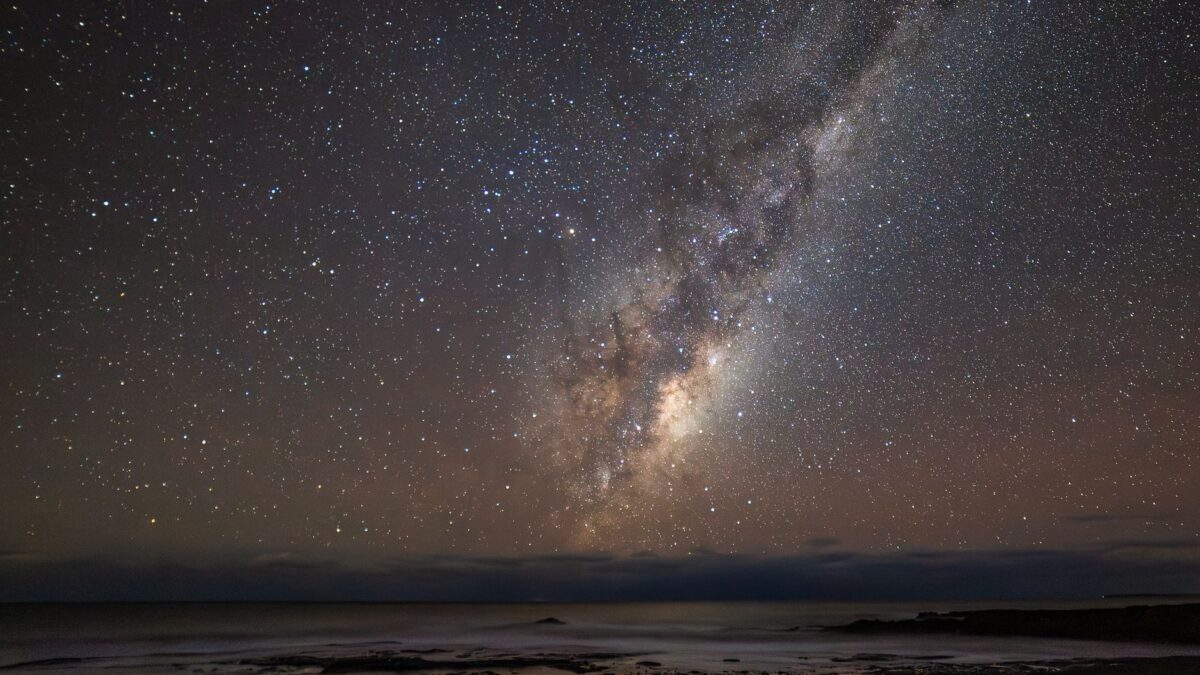
From the United States, the brightest part of the Milky Way, its core in the constellation Sagittarius, is best seen from June through August, low in the southern sky on moonless nights. You need a truly dark site: a 2016 light pollution atlas found that nearly 80% of North Americans cannot see the Milky Way from home.
On a dark summer night the Milky Way looks like a pale, uneven cloud running from the northeast horizon, overhead and down into the south. Near the southern horizon it thickens and brightens into a bulge crossed by dark lanes of dust. That bright region is the direction of the galaxy’s center, which NASA puts at roughly 26,000 to 27,000 light-years away.
When is the Milky Way core visible from the US?
The core is easiest to see in Northern Hemisphere summer. NASA calls June the start of Milky Way “core season”, when the band arches across the sky toward the south and is visible all night from dark locations. The National Park Service gives June through August as the best months for views of the galactic center at its northern parks.
Outside those months the core is still there, just at awkward hours. In spring it rises in the southeast late at night and is best in the hours before dawn. By September and October it is already low in the southwest soon after dark and sets earlier each week. In winter the core is behind the Sun, and the fainter outer arms of the galaxy cross the sky instead.
| Season (US) | Where the core is | Best time to look |
|---|---|---|
| March to May | Rises in the southeast after midnight | The last 2 to 3 hours before dawn twilight |
| June to August | Low in the south, highest around midnight | From the end of evening twilight onward |
| September to October | Low in the southwest after dark | The first hours after evening twilight |
| November to February | Near the Sun, not visible | Look for the fainter winter Milky Way instead |
The farther south you live, the higher the core climbs. From the southern states it rises well clear of the horizon haze; from the northern border it skims low, and a hill or tree line to the south can hide it.
How dark does the sky need to be?
The sky needs to be far darker than most suburbs. The 2016 world atlas of artificial sky brightness, published in Science Advances and summarized by NOAA, found the Milky Way is hidden from more than one-third of humanity, including about 60% of Europeans and nearly 80% of North Americans. More than 99% of people in the US and Europe live under light-polluted skies, the authors reported.
Amateur astronomers often rate skies on the Bortle scale, a nine-class system published in Sky & Telescope in 2001. Class 1 is an excellent dark site, where the Milky Way is so bright it can cast faint shadows. Class 9 is an inner-city sky. The lower the number, the more structure you see in the band; in most suburbs the faint parts disappear.
Two practical tools help you find dark sites:
- Light pollution maps. Free online maps built from satellite data color-code sky brightness. Look for gray, blue or green zones, ideally an hour or more from a large city.
- Certified dark-sky places. DarkSky International certifies parks, reserves and communities that limit outdoor lighting. Many have public stargazing programs.
Light domes from cities spread far. If a city lies to your south, its glow will sit right where the core rises, so pick a site with the darkest horizon in that direction.
How does the Moon affect the view?
Moonlight washes out the Milky Way almost as badly as city light. The best nights are the week around new Moon, or nights when the Moon sets before the sky gets dark or rises after you plan to leave. A thin crescent low in the west after sunset does little harm once it sets.
Our full Moon calendar gives the dates to avoid. Summer new Moons also line up well with the Perseid meteor shower in some years; check our meteor shower calendar for the current year’s Moon phase at the peak.
How do you see the Milky Way step by step?
- Choose a night near new Moon between June and August, with a clear forecast.
- Find a dark site on a light pollution map with an open view to the south.
- Arrive before the end of twilight so you can set up while you can still see.
- Turn off all white lights and phone screens. Use a dim red light if needed.
- Give your eyes 20 to 30 minutes to adapt to the dark. Each glance at a bright screen resets part of that.
- Face south and look low. Find the Teapot shape of Sagittarius; the brightest part of the Milky Way rises like steam from its spout.
- Follow the band upward and to the north, through the Summer Triangle of bright stars almost overhead.
Binoculars are worth bringing. Sweeping slowly along the band turns the glow into thousands of stars and small clusters.
You will likely notice moving dots of light too. Most are satellites; our guide on how to see Starlink satellites explains how to tell them apart.
What camera and phone settings capture the Milky Way?
A phone with a night or astrophotography mode, held steady on a tripod, can record the Milky Way core from a dark site. The phone stacks several exposures over a few seconds to tens of seconds. Turn off the flash, lean the phone against something solid if you have no tripod, and let the full exposure run.
With a camera, a common starting point is:
- A wide lens at its widest aperture (for example f/2.8 or faster).
- Manual focus on a bright star, zoomed in on the screen until it is a sharp point.
- ISO 1600 to 6400, depending on the camera’s noise.
- Exposures of about 10 to 25 seconds. Longer ones show stars stretching into short trails as Earth turns, and the limit is shorter for longer lenses.
- A 2-second timer or remote release so pressing the button does not shake the tripod.
Treat these as starting values and adjust after checking the first frame. Shooting in RAW makes it easier to correct color and brightness later.
Bottom line
For the Milky Way at its best, go out on a moonless night between June and August, drive to a site that shows dark on a light pollution map, face south and give your eyes half an hour. Clouds, haze and moonlight all change the view, so pick a few candidate nights rather than one.
FAQ
Can you see the Milky Way from a city?
Usually not. Light pollution hides the band from most large cities and many suburbs, which is why the 2016 atlas found that nearly 80% of North Americans cannot see it from where they live.
Why is the Milky Way brighter in summer?
In Northern Hemisphere summer, the night side of Earth faces toward the center of the galaxy, where stars are densest. In winter we look out toward the thinner outer parts of the disk.
Does the Milky Way look like the photos?
Not quite. To the eye it is a gray, cloudlike band with dark lanes, while photos gather light for many seconds and bring out color and faint detail.
What is the Milky Way made of?
It is our home galaxy, a flat disk of stars, gas and dust that we see edge-on from inside, so it looks like a band across the sky. Astronomers also infer a large halo of invisible dark matter from the way the galaxy rotates.