How Birds Know Where to Migrate: Instinct, Compasses, Maps
Birds migrate using inherited instructions, a magnetic compass, the sun and stars, and learned landmarks. Young birds often fly their first trip without a guide.
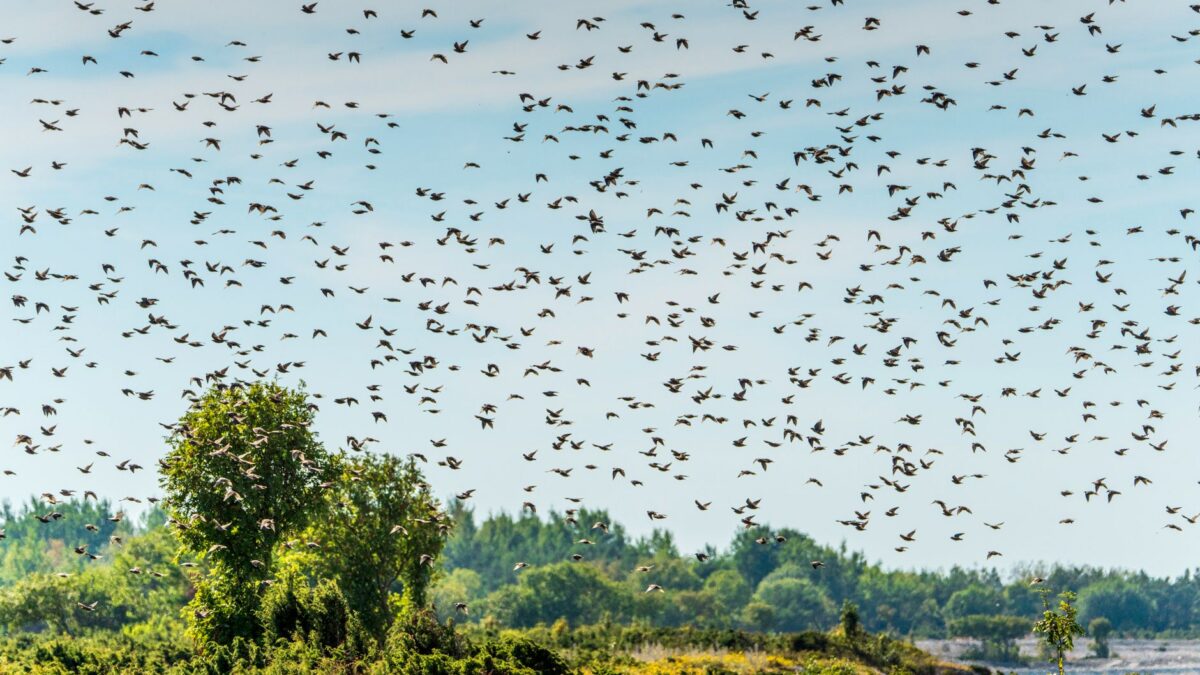
Birds know where to migrate through a mix of inherited instructions and several built-in navigation tools. Many species are born with a rough program for which direction to fly and for how long, and they steer with a magnetic sense, the position of the sun and the pattern of the stars. Experience then refines the route: social species such as cranes and geese learn it from their parents, while many songbirds make a first trip alone and improve with every later one.
Is migration instinct or learned?
For many songbirds, the basic plan is inherited. Researchers have raised young birds in captivity, with no contact with adults, and watched them during the season when wild birds migrate. The caged birds grow restless at night and hop or flutter in the direction their wild relatives would fly, a behavior called migratory restlessness. Experiments with blackcaps, a small European warbler, showed that the preferred direction and the timing of the restlessness can be passed down in the genes, and that breeding birds from different populations can produce offspring that choose an in-between direction.
Other species depend more on teaching. Young cranes and geese travel with family groups and follow their elders, so the route is a cultural tradition passed along from year to year. Many songbirds, shorebirds and cuckoos make the first trip on their own, which means they rely almost entirely on inherited instructions the first time through.
What tells a bird when to leave?
The signal for departure comes from the calendar and the body. Changing day length acts on hormones, and birds put on fat for the flight. Weather, food supply and wind then help decide the exact day. Many birds wait for favorable tailwinds before setting out.
How does a bird sense direction?
Birds use more than one compass, and they cross-check them.
- Magnetic field. Experiments show that many migrants can sense Earth’s magnetic field and use its direction and angle. One leading idea is that light-sensitive proteins called cryptochromes in the eye react to the field. The exact mechanism is still being studied.
- The sun. Birds can use the sun’s position and adjust for the time of day, as long as they have an internal clock.
- The stars. Experiments with indigo buntings in planetarium-style setups showed that night migrants can learn the pattern of stars that rotates around the pole and use it to find north. A look at the night sky during the Geminid meteor shower shows the same dark sky these birds read.
- Polarized light. The pattern of polarized light at sunrise and sunset gives a reference that helps calibrate the other compasses.
How do birds find a specific place?
A compass tells a bird which way is north. A map tells it where it is. Experienced birds seem to have both. Studies in which adult birds were moved long distances from their normal route showed that adults often correct their course toward the usual destination, while inexperienced young birds keep flying in the original direction and end up displaced.
Researchers think birds may use gradients in Earth’s magnetic field, such as its strength and angle at different latitudes, as part of a map. Landmarks, coastlines, mountain ranges and rivers also help, and some seabirds appear to use smell to find their way over open water. Many birds return to the same nesting and wintering sites year after year, sometimes to the same tree or the same pond.
How far can migrating birds travel?
Distances vary widely. Some birds shift only a short way down a mountain or to a milder part of the same country. Others fly across continents and oceans, and a few cross open ocean for days without landing. Tracking devices small enough for songbirds have shown that some tiny birds travel thousands of miles each way. Scientists learned much of this by banding birds, a method also used to work out how long animals live, and now with lightweight tags and radar.
What can go wrong on the way?
Storms, bright city lights and glass windows can disturb or kill migrating birds, and loss of stopover habitat removes places to rest and feed. The U.S. Fish and Wildlife Service publishes information on migratory bird conservation, and the Cornell Lab of Ornithology offers resources on bird migration for the public.
Quick answers
Do all birds migrate?
No. Many species stay in the same area all year, and some migrate only in part of their range. Whether a bird migrates depends on the species, the population and the food available.
Do young birds follow their parents?
Some do, including cranes and geese. Many small songbirds fly their first migration alone and often leave after their parents.
Why do birds fly in a V shape?
Larger birds such as geese often fly in a V or a line. The formation is thought to save energy and help the group stay together, but it does not apply to every species.
Can birds get lost?
Yes. Young birds in particular sometimes end up far from their normal range, which is one reason a rare bird occasionally turns up in an unexpected place.