How to See Starlink Satellites: When to Look and Why Trains Fade
A line of moving lights across the night sky is almost always a fresh batch of Starlink satellites. Here is when they show up, how to predict a pass and why the show is short.
Starlink satellites are easiest to see as a “train,” a line of evenly spaced moving lights, in the first few days after a SpaceX launch. Look in the hour or two after sunset or before sunrise, when your sky is dark but the satellites overhead are still in sunlight. After a week or two the train spreads out and fades.
The train effect is temporary. Once the satellites climb to their working orbit and turn to their normal orientation, most become too faint to notice without help, although individual satellites can still be spotted on dark nights.
Why do Starlink satellites look like a train?
A Falcon 9 releases a batch of Starlink satellites together in a stack, and they slowly drift apart in a single line along the same orbit. Seen from the ground, that line looks like a string of pearls moving steadily across the sky, all following the same path one after another.
The satellites themselves give off no light. What you see is sunlight reflecting off their bodies and solar arrays. Right after deployment they fly lower than their final orbit, which makes them closer and brighter, and they are still close together.
When is the best time to look?
The best time is roughly 30 minutes to two hours after local sunset, or the same before sunrise, during the first one to three days after a launch. At those times the ground is in darkness but sunlight still reaches satellites a few hundred miles up.
- Too early: the sky is too bright to see faint points of light.
- Middle of the night: the satellites usually pass through Earth’s shadow and are invisible, except near midsummer at higher latitudes.
- Weather: you need a mostly clear sky in the direction of the pass.
Not every launch produces a good train over your area. Visibility depends on the orbit, your latitude and the time of day the train passes over you.
How do you find out when a Starlink train will pass over you?
Use a satellite tracking website or app that loads the latest orbit data and predicts passes for your location. There is no official NASA tool for Starlink passes; NASA’s Spot the Station service covers only the International Space Station.
- Check SpaceX’s launches page for a recent Starlink mission and note the launch date and site.
- Open a tracking site such as Heavens-Above or a satellite tracker app, and set your exact location.
- Look for passes listed for the newest Starlink group, with a start time, direction and maximum height above the horizon.
- Go outside five minutes early, face the starting direction and let your eyes adjust.
Passes listed as high in the sky (more than about 40 degrees above the horizon) are usually brighter and easier to see than low ones.
Why do Starlink trains fade after a few days?
Trains fade for three main reasons: the satellites spread apart, climb to a higher orbit, and change orientation to reflect less light toward the ground.
During orbit raising, the satellites use their thrusters to climb to their operating altitude over several weeks. As they climb they get farther away and dimmer. They also drift apart, so the tight line breaks up into scattered single points. SpaceX has also changed the satellites’ design and how they fly, including darker surfaces and mirror films on newer satellites, to cut how much sunlight they reflect. Astronomers still track Starlink brightness closely, because even faint satellites leave streaks in telescope images.
How can you tell Starlink from a plane, a star or the ISS?
Starlink satellites move steadily, do not blink and travel in groups or lines. Aircraft have blinking red and green lights and often make engine noise. Stars do not move against each other.
| Object | What it looks like | How long it is visible |
|---|---|---|
| New Starlink train | Many steady points in a line, same path | A few minutes for the whole line |
| Single Starlink satellite | Faint steady point moving smoothly | A few minutes, often fades out mid-sky |
| International Space Station | One very bright steady light, brighter than any star | Up to about 7 minutes |
| Airplane | Blinking colored lights, sometimes a steady white light | Long, with sound nearby |
| Meteor | A brief streak | Under a second or two |
A satellite that suddenly fades halfway across the sky is entering Earth’s shadow. If you want to compare with the brightest satellite of all, see our guide on how to see the ISS.
Can you photograph a Starlink train?
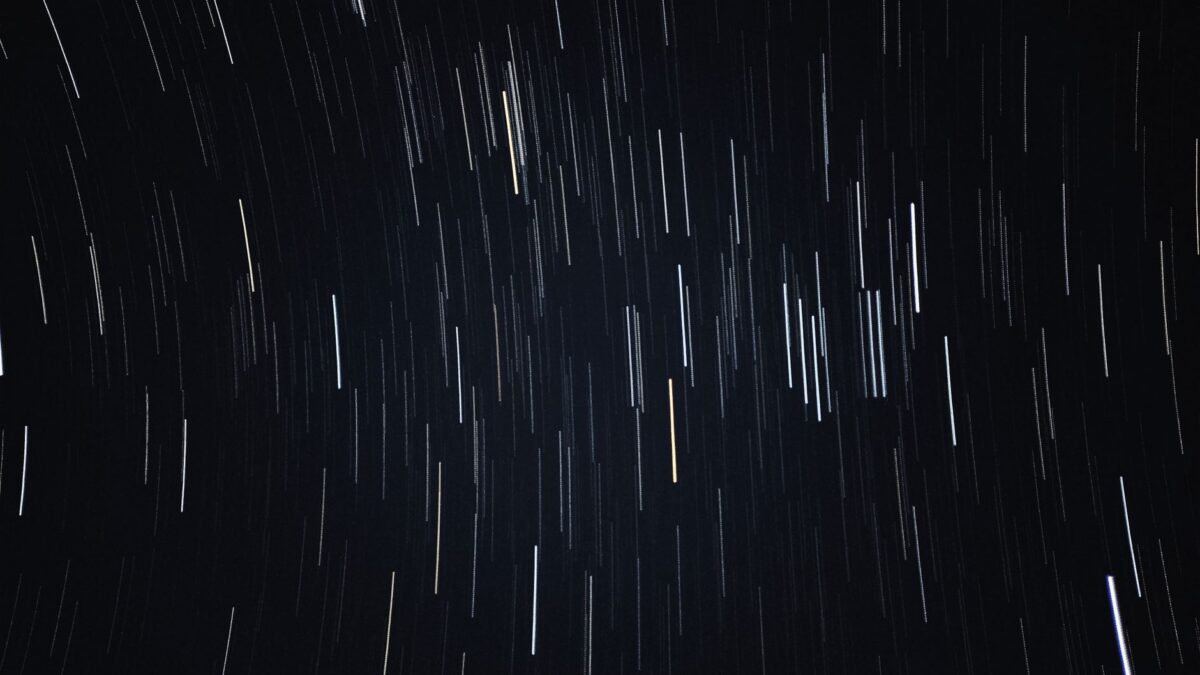
Yes. Use a camera or phone on a tripod in night or manual mode with an exposure of several seconds. The satellites will appear as a set of parallel streaks. Start the exposure as soon as the first satellite appears and keep the camera still. For moving video, a fast lens and a high ISO setting work better than long exposures.
The same dark-sky habits help with other sky events, such as the showers listed in our meteor shower calendar.
Bottom line
To see a Starlink train, check for a Starlink launch in the last one to three days, look up a pass for your location with a tracking site, and go out in the first hour or two after sunset or before dawn. After about a week the line breaks up and the satellites grow too faint for most people to notice.
FAQ
Why did I see a line of lights in the sky?
A straight line of evenly spaced, steady lights moving together is almost always a recent batch of Starlink satellites. They are visible for a few days after launch, around dusk and dawn.
Can you see Starlink satellites every night?
Individual satellites pass over most nights, but most are too faint to notice once they reach their operating orbit. The bright train effect lasts only a few days after each launch.
Are Starlink satellites visible from cities?
A fresh train can be bright enough to see from suburbs and some cities. Older, higher satellites usually need darker skies away from streetlights.