Bioluminescent Animals: How and Why Living Things Glow
Glowing waves, flashing fireflies and deep-sea fish with lanterns all use the same trick: a chemical reaction that makes cold light. Here is how it works and what animals use it for.
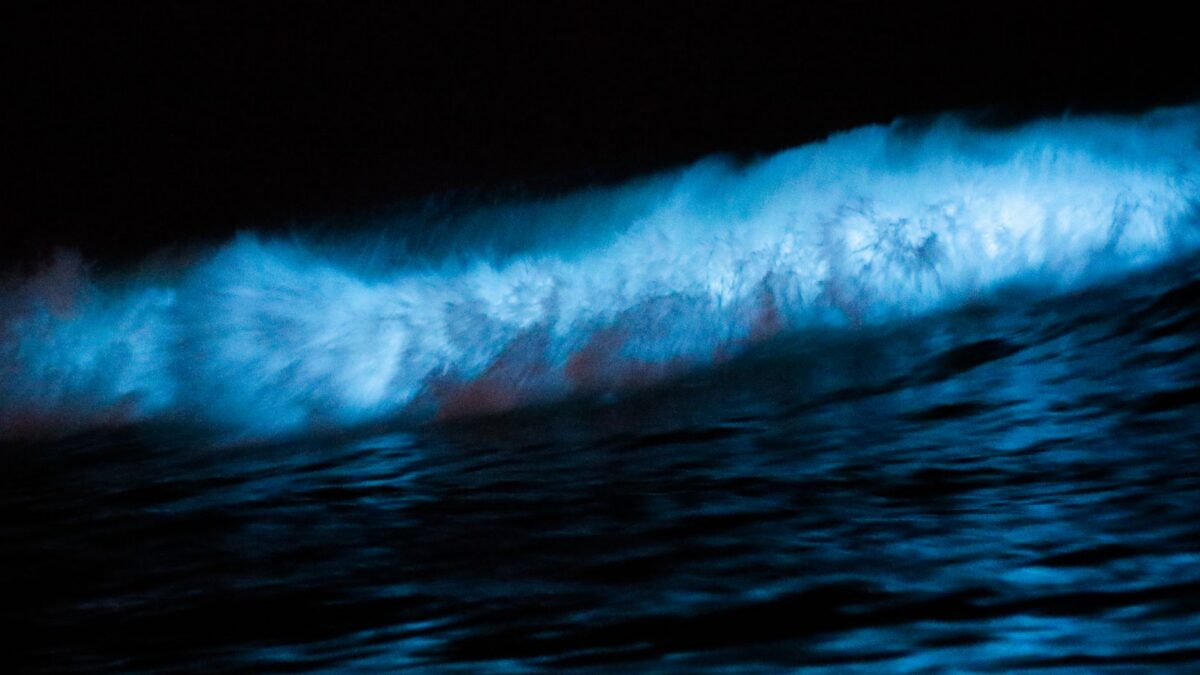
Bioluminescence is light produced by a living organism through a chemical reaction, usually between a molecule called luciferin and an enzyme called luciferase. It is common in the ocean: a 2017 study of Monterey Bay found that about three-quarters of animals from the surface to about 3,900 meters can make their own light, and most of that light is blue.
On land the best-known example is the firefly blinking over a summer lawn. At sea it is waves that break in streaks of electric blue on a dark beach, or a deep-sea fish dangling a glowing lure in front of its jaws. The chemistry differs between groups, but the principle is the same: energy from a reaction is released as light instead of heat.
How does bioluminescence work?
Bioluminescence works when an enzyme speeds up a reaction that releases energy as light. In most systems, the luciferase enzyme helps a luciferin molecule react with oxygen, and the product gives off a photon as it settles into a lower-energy state. The bioluminescence lab of Michael Latz at Scripps Institution of Oceanography describes the two chemicals combining, with the luciferase acting as the enzyme that lets the luciferin release its energy.
The light is “cold”: very little of the energy is lost as heat, which is why a firefly does not burn itself.
Not every glowing animal makes the light itself. Some, such as many deep-sea anglerfish, carry light-producing bacteria in a special organ and give them a home in exchange for the glow.
Why is most ocean bioluminescence blue?
Most marine bioluminescence is blue because blue light travels farthest through seawater. NOAA Ocean Exploration notes that light from living things ranges from nearly violet to green-yellow, and only very rarely red.
Blue-green light also matches what most deep-sea eyes are tuned to detect, so a flash in that color is the one most likely to be seen by a mate, a rival or a meal.
How common is bioluminescence in the deep sea?
It is the rule rather than the exception. NOAA Ocean Exploration says about 80% of animals living between 200 and 1,000 meters (656 to 3,280 feet) in open water are bioluminescent.
A larger count came from the Monterey Bay Aquarium Research Institute (MBARI). Séverine Martini and Steven Haddock reviewed video from 240 dives by remotely operated vehicles between 1999 and 2016, covering animals larger than about 1 centimeter seen from the surface to about 3,900 meters, more than 350,000 individuals in all. Their 2017 paper in Scientific Reports (doi.org/10.1038/srep45750) found that about three-quarters of the animals could produce light.
| Group (Monterey Bay study) | Share able to glow |
|---|---|
| All animals larger than 1 cm, surface to about 3,900 m | 76% |
| Jellyfish and other cnidarians | More than 97% |
| Siphonophores | 99.7% |
| Comb jellies (ctenophores) | 91.8% |
The study has limits worth knowing. It covers one region, a share of the fishes and crustaceans could not be classified either way, and some fast swimmers may have fled the vehicle’s lights. The ratio of glowing to non-glowing animals stayed fairly steady with depth.
For a tour of the creatures that live down there, see our guide to what lives in the deep sea.
Why do animals glow?
Animals use light to find food, avoid being eaten and find mates, though for many species the exact purpose is still unknown. NOAA Ocean Exploration says the main purpose in many cases has not been worked out. The best-studied uses fall into a few groups:
- Luring prey. Anglerfish dangle a glowing lure in front of their mouths. Prey swim toward the light the way fish approach a lit fishing lure.
- Hiding. Some fish, squid and shrimp have light organs on their bellies that match the faint light coming from above. This counterillumination erases their silhouette for predators looking up.
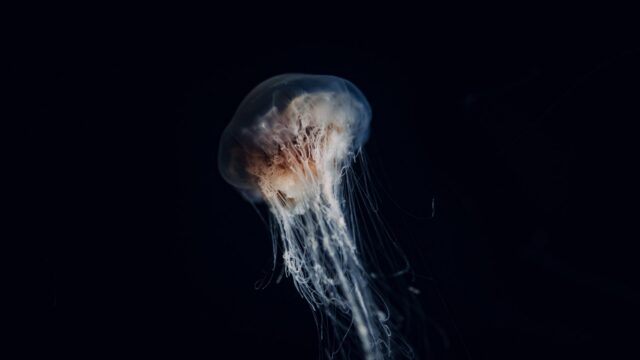
- Startling or distracting predators. Some shrimp and squid release clouds of glowing fluid, the light-producing version of an ink cloud. Many jellyfish flash when touched.
- The “burglar alarm.” Small plankton that flash when grabbed may attract larger predators that eat whatever is attacking them. It is a long-standing hypothesis that is hard to test in the open ocean.
- Finding mates. Fireflies are the clearest example. Different species use different flash patterns, and males and females answer each other’s signals.
Octopuses mostly hide with color and skin texture rather than light, but a few deep-sea relatives do glow. Our piece on octopus intelligence covers how their camouflage works.
Where can you see bioluminescence yourself?
The easiest places to see it are dark beaches during plankton blooms and fields or woods with fireflies on warm summer nights. Glowing waves come from tiny single-celled plankton called dinoflagellates. Scripps Institution of Oceanography explains that when these plankton are disturbed by waves or other movement at night, they give off a neon-blue glow.
Blooms are unpredictable. They can appear for a few nights or a few weeks and then vanish, and local news, aquariums or marine labs are often the first to report one. To give yourself the best chance:
- Go on a moonless night, or after the Moon has set, and stay away from streetlights.
- Let your eyes adjust for 15 to 20 minutes before judging what you see.
- Watch the breaking edge of waves, wet sand where water runs back, or footprints in wet sand.
- Do not use a flash or bright phone screen; the glow is faint and easily drowned out.
- Follow local beach advisories, which sometimes accompany large blooms.
Fireflies are easier to find. In much of the US they flash on warm, humid evenings in early summer, especially near grassy fields and woodland edges away from bright lights.
Bottom line
Bioluminescence is light made by a chemical reaction, usually luciferin reacting with oxygen with help from a luciferase enzyme. It is everywhere in the deep ocean, where about three-quarters of animals in the Monterey Bay survey could glow. Animals use it to hunt, hide, scare off predators and signal to mates, and on the right night you can watch plankton light up a beach.
FAQ
Is bioluminescence the same as glow-in-the-dark paint?
No. Glow-in-the-dark materials store light and release it slowly. Bioluminescent organisms make new light through a chemical reaction, without needing to absorb light first.
What is the difference between bioluminescence and fluorescence?
Fluorescent animals absorb light of one color and give it back as another, so they need an outside light source. Bioluminescent animals produce their own light.
Do any land animals glow besides fireflies?
Yes. Some click beetles, fungus gnat larvae and a number of fungi glow, though bioluminescence is far more common in the ocean than on land.
Why does the ocean glow more in some places than others?
Glowing water depends on how many dinoflagellates or other luminous plankton are present. Their numbers rise and fall with water temperature, nutrients and currents, which is why blooms come and go.