Why Don’t Birds’ Feet Freeze? Heat Exchange, Scales and Posture
Birds' feet don't freeze because warm and cold blood swap heat in the legs and the feet have little tissue to keep warm. How ducks stand on ice.
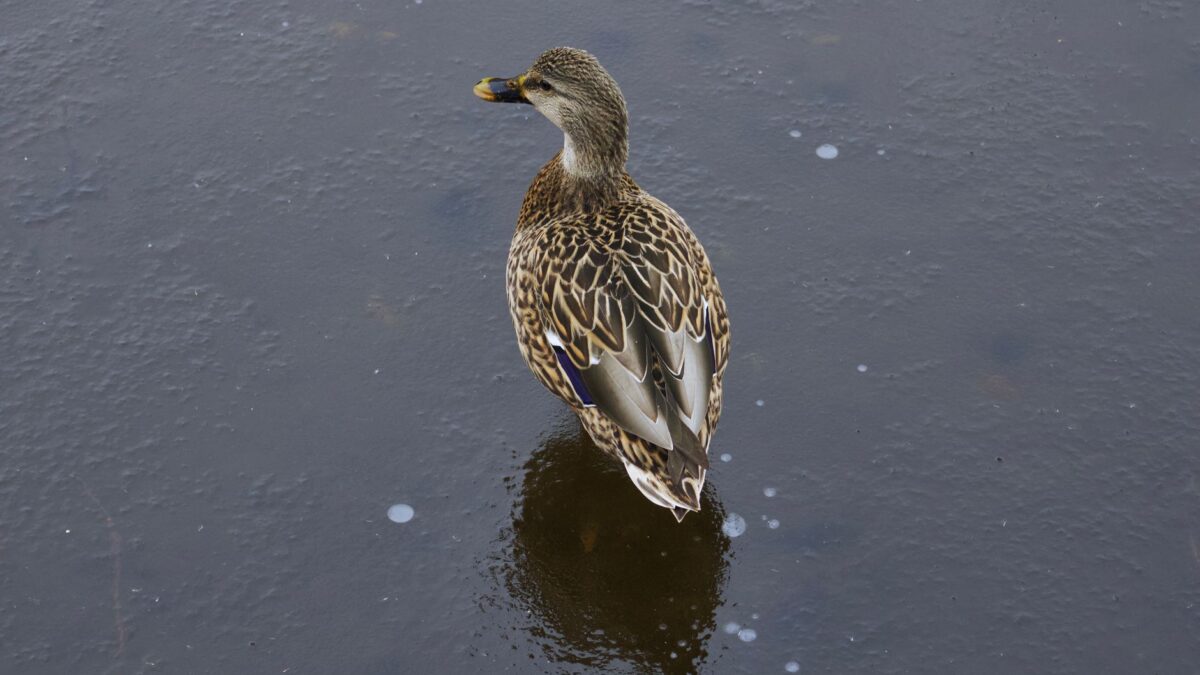
Birds’ feet don’t freeze on ice and snow because blood vessels in their legs work as a heat exchanger: warm blood flowing down to the feet passes right next to cold blood coming back up, so most of the heat returns to the body before it reaches the toes. The feet run cold, often only a little above freezing, which means they lose very little heat to the ice. Bird feet are also mostly bone, tendon and tough scaly skin, with few muscles and nerves that need warmth to work.
A mallard standing on a frozen pond or a gull resting on packed snow is not suffering. Its feet are simply kept at the lowest temperature that keeps the tissue alive.
How does countercurrent heat exchange work in a bird’s leg?
Countercurrent heat exchange is a layout in which arteries and veins run side by side in opposite directions, so heat moves from the outgoing warm blood to the returning cold blood. In many birds the vessels in the lower leg form a dense mesh, called a rete mirabile (Latin for “wonderful net”), which gives the two streams a large contact area.
The result works in two directions at once:
- Arterial blood cools on its way down, so it arrives at the foot already chilled and has little heat left to give away.
- Venous blood warms on its way up, so it does not chill the bird’s core when it gets back to the body.
Engineers use the same principle in industrial heat exchangers. Fish, whales, seals and some land mammals have similar vessel arrangements in fins, flippers and limbs.
Why don’t cold feet hurt or stop working?
Cold feet keep working because the muscles that move a bird’s toes sit higher up, in the warm, feathered part of the leg. Long tendons run down to the toes, so a bird can grip a branch or walk on ice without needing warm muscle in the foot itself.
The foot has relatively few nerve endings and little soft tissue. The skin is covered with hard scales made of keratin, the same protein as fingernails and beaks. Less living tissue means less to protect, and less heat needed to protect it.
Birds can also adjust blood flow. When the feet get close to freezing, vessels open enough to send a little extra warm blood down and keep the tissue just above the danger point. When a bird is too hot, it can send more blood to the feet and legs to dump heat.
What else do birds do to keep their feet warm?
Birds also use posture and behavior to protect their feet in winter. Common habits include:
- Standing on one leg and tucking the other foot into the belly feathers, then switching.
- Crouching down so the breast feathers cover both feet, which you often see in songbirds on a cold feeder perch.
- Fluffing up their feathers to trap a thicker layer of warm air around the body and legs.
- Resting with the bill tucked under the wing to cut heat loss from the face.
- Roosting in groups, in tree cavities or in dense evergreens out of the wind.
Some species have extra gear. Ptarmigan and some grouse grow feathers on their feet in winter, which act like insulated boots on soft snow. Many grouse also grow comb-like fringes on their toes that work as snowshoes.
Do birds’ feet ever freeze to the ice?
Birds’ feet rarely freeze to ice because the foot surface is cold and fairly dry, so there is little melting and refreezing under it. Trouble can start when a bird stands in water or slush and the wet foot then touches metal or ice in a hard freeze. Wild birds sometimes lose toes to frostbite, and injured, sick or underfed birds are most at risk because they have less energy to spend on circulation.
Snow and ice behave differently underfoot. Fresh snow traps a lot of air (the reason snow looks white while ice is clear), so it insulates better than bare ice, and a bird on powder loses heat more slowly than one on a frozen puddle.
Can pet birds and backyard chickens get frostbite?
Pet birds and backyard chickens can get frostbite, mainly on combs, wattles and toes, because many domestic breeds are less adapted to hard cold than wild birds that winter in the north. Damp air in a closed coop makes it worse, since moisture from breath and droppings settles on skin.
Mainstream advice from poultry and veterinary sources is consistent:
- Keep the coop dry with good ventilation near the roof, without drafts at roost height.
- Use wide, flat roost bars so chickens can cover their toes with their bodies while they sleep.
- Make sure birds always have unfrozen water and enough feed, since digestion produces body heat.
- Check feet and combs for pale, gray, black or swollen areas, and call a vet if you see them.
- Do not rub frostbitten tissue or warm it quickly with a heat source.
University extension services publish winter care guides for small flocks; the Penn State Extension site is one place to start. For a pet parrot or other caged bird, a vet who treats birds is the right call for any injury.
How can you help wild birds in freezing weather?
Wild birds handle cold well on their own if they have food, water and shelter. You can help by keeping feeders stocked with high-energy foods such as black oil sunflower seed and suet, offering open water in a heated birdbath, and leaving dense shrubs, evergreens and brush piles where birds can roost out of the wind.
The Cornell Lab of Ornithology publishes advice on winter feeding and on identifying the species that visit feeders. If you find a bird that seems unable to move, contact a licensed wildlife rehabilitator rather than trying to warm it at home. Most native wild birds in the US are protected by federal law, as the U.S. Fish and Wildlife Service explains.
Quick answers
Do ducks feel cold on ice?
Ducks sense cold, but their feet are kept at a low temperature with little feeling and little heat to lose, so standing on ice costs them very little energy. Their bodies stay warm under waterproof feathers and down.
Why do birds stand on one leg in winter?
A bird standing on one leg tucks the other foot into its feathers, which halves the bare skin exposed to cold air and ice. Birds switch legs from time to time.
Do birds have the same heat exchange in their beaks?
Birds lose heat through their bills too, and many tuck the bill into their back feathers while resting in the cold. Some species with large bills adjust blood flow to the bill to shed or save heat.
How do birds’ legs compare with their dinosaur ancestors?
Birds inherited scaly lower legs and three main forward-facing toes from theropod dinosaurs, along with other features such as the wishbone that birds share with some dinosaurs.