Oregon State Material Captures CO2 From Humid Gas With Just 4% CO2
Oregon State chemists made a porous material, BVR-X, that captures carbon dioxide from humid exhaust and survives dozens of reuse cycles.
Chemists at Oregon State University have made a porous material called BVR-X that captured carbon dioxide from a very humid gas stream containing only 4% CO2 in laboratory tests. The material kept working after dozens of capture-and-release cycles, according to the university.
Water vapor is a standing problem for industrial carbon capture, because factory exhaust is full of it. The team reports that BVR-X handles the moisture by sorting it away from the carbon dioxide inside its own structure. The work appears in Angewandte Chemie International Edition, and the researchers have filed a patent application.
What kind of material is BVR-X?
BVR-X belongs to the metal-organic frameworks, or MOFs. These crystals are built from metal ions joined by organic molecules called ligands. The ions act as nodes and the ligands as linkers, and together they form repeating, cage-like structures with extremely small pores. Gas molecules stick to the pore surfaces in a process called adsorption, comparable to the way a sponge holds liquid.
Chemists can swap in different metals and linkers to tune a MOF for a given job. Kyriakos Stylianou, a chemistry professor at Oregon State who directs its Materials Discovery Laboratory, said millions of MOF designs are theoretically possible. Researchers have synthesized more than 100,000 of them and predicted the properties of hundreds of thousands more.
Why does water cause trouble?
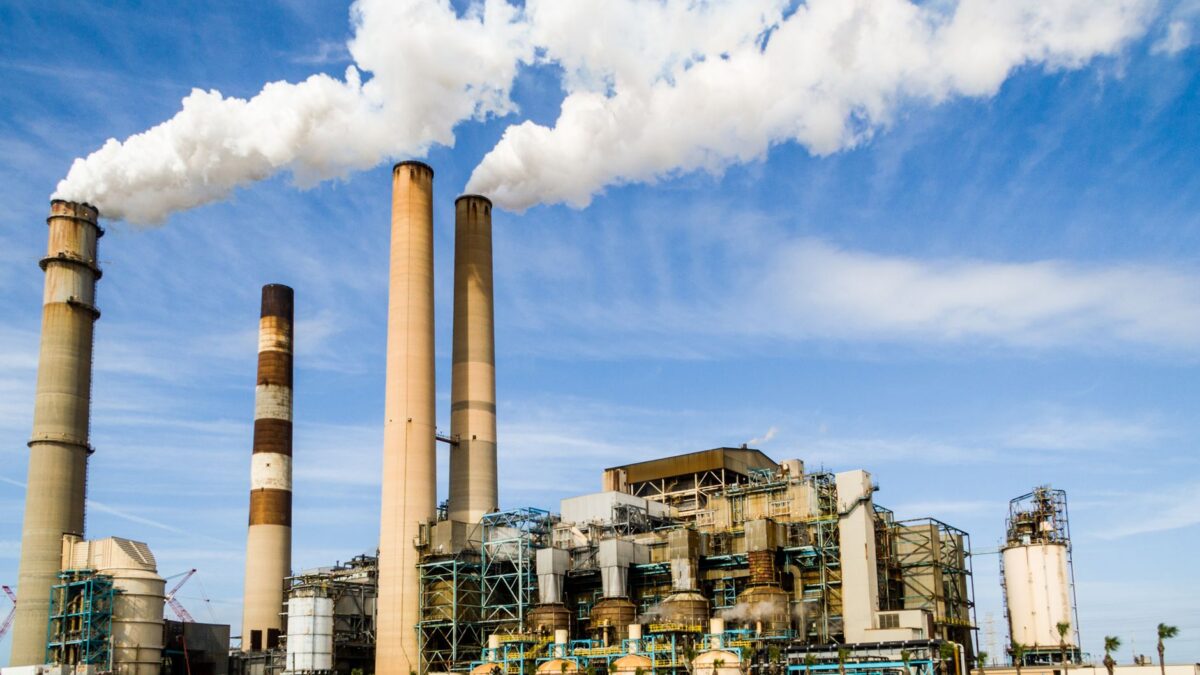
Carbon capture can work in two places. Direct air capture pulls CO2 out of the atmosphere, and the world’s largest such plant opened in Iceland in 2024. Stylianou said it captures about as much CO2 in a year as roughly 7,200 cars produce. The other option is to catch the gas at factories and power plants before it leaves the smokestack, and that technology is more established.
Exhaust from those sources carries a lot of water vapor. Many MOFs perform well in dry laboratory conditions but lose much of their capture ability in the humid gas of a real smokestack. Drying the gas first is possible, but it needs extra equipment and energy, and the cost can make the whole process impractical.
How the new material handles moisture
According to the university, BVR-X has an internal structure that keeps water and carbon dioxide largely apart within its pores. Each substance is directed to a different region, so water molecules do not take up the spots the CO2 needs.
“Our new material does something unusual: It responds to water by changing in a way that lets it keep capturing CO2 effectively even under very humid conditions,” Stylianou said.
The team tested it on a highly humid gas with 4% carbon dioxide. That is a low share, similar to what comes out when natural gas is burned, and it is hard to separate when water vapor is also present. The material also captured and released CO2 repeatedly over dozens of cycles without losing effectiveness. Commercial systems have to reuse their capture material many times to keep costs manageable.
Why it matters
Industry accounts for 30% of total greenhouse gas emissions in the United States, according to the Environmental Protection Agency. Burning fossil fuels for energy is one of the major sources of that carbon dioxide. A material that works in wet exhaust without a drying step could make capture at these facilities cheaper and more practical, the researchers say.
The results so far come from laboratory experiments. The sources do not describe tests in a working industrial plant, so how BVR-X performs at scale and over longer periods is not yet known.
Who did the work
Stylianou worked with Ankit Yadav, Emmanuel Musa and Andrzej Gładysiak of his lab, and with Micah Hickethier, Chun-Wai Chang and Kai Shen Choong of the Oregon State College of Engineering. Other collaborators came from the University of California, Berkeley, the University of Oregon and the ARAMCO Research and Development Center.
Funding came from Saudi Aramco, the Murdock Charitable Trust and a donor-advised fund set up through the OSU Foundation by alumni Brian and Marilyn Kleiner. The paper, titled “Pore Compartmentalization of CO2 and H2O in a Redox-Active Adsorbent,” is in volume 65, issue 46 of the journal (DOI 10.1002/anie.9809119).
Source: ScienceDaily