Why Dinosaur Fossils Sell for Millions: Sue, Stan, Apex
Dinosaur skeletons sell for millions because rare, complete specimens from US private land can be legally sold. Sue, Stan and Apex set the records.
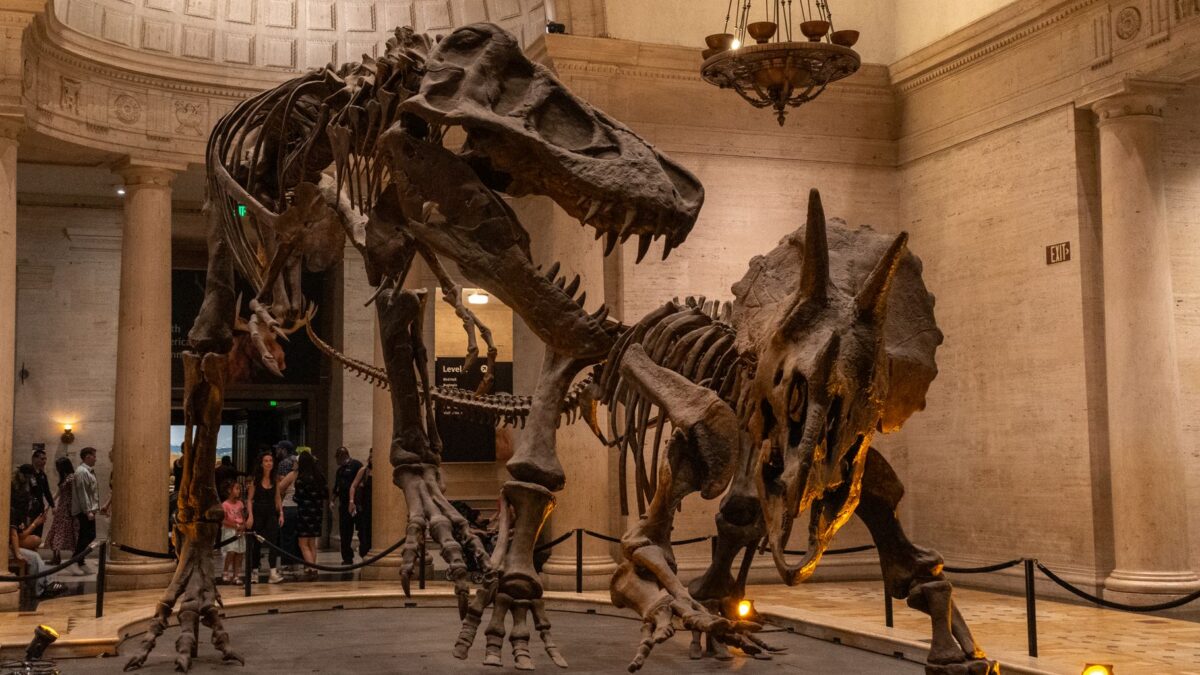
Dinosaur skeletons sell for millions because a few are close to complete, they are rare, and in the United States it is legal to sell fossils collected on private land. Sue, a Tyrannosaurus rex, sold for $8.3 million in October 1997. Stan, another T. rex, reached $31.8 million in 2020, and a Stegosaurus called Apex reached $44.6 million in 2024. Many paleontologists object because a specimen in a private collection can be closed to research.
What did Sue, Stan and Apex sell for?
According to Wikipedia’s article on Sue, the skeleton was found on Aug. 12, 1990, in cliffs on the Cheyenne River Indian Reservation in South Dakota by the fossil collector Sue Hendrickson, who gave it its name. More than 90% of it was recovered by bulk. A long dispute over ownership ended with a court deciding that the landowner, Maurice Williams, kept the fossil, and he hired Sotheby’s to sell it. The Oct. 4, 1997, auction opened at $500,000, and the Field Museum in Chicago won with a bid of $7.6 million. The final cost was $8,362,500. The museum raised the money with help from the California State University system, Walt Disney Parks and Resorts, McDonald’s, Ronald McDonald House Charities and individual donors.
Stan was spotted in 1987 by Stan Sacrison, an amateur paleontologist, who saw a pelvis sticking out of a cliff near Buffalo, South Dakota. The Black Hills Institute began excavating on July 11, 1992. Wikipedia’s article on Stan calls it the fifth most complete T. rex found so far, at more than 70% by bulk, and says its skull is widely regarded as the best T. rex skull ever discovered. The October 2020 auction price of $31.8 million was the highest paid for a dinosaur at that point. The Abu Dhabi Department of Culture and Tourism acquired Stan, and the skeleton went on display at the Natural History Museum Abu Dhabi, which opened on Nov. 22, 2025.
Apex is a Stegosaurus of uncertain species, found in May 2022 by the commercial paleontologist Jason Cooper on private land in Moffat County, Colorado. Wikipedia’s article on Apex gives its age as about 150 million years and its size as 3.4 meters (11 ft) tall and 8.2 meters (27 ft) long, with 254 bones preserved out of approximately 319. Sotheby’s sold it in New York on July 17, 2024. Seven bidders took part, the bidding started at $3 million, and after 15 minutes the hammer fell at $44.6 million, which was 11 times the lower end of the $4 million to $6 million pre-sale estimate. The buyer was Kenneth Griffin, founder and CEO of the hedge fund Citadel LLC. Bones that were missing were replaced with sculpted and 3D-printed replicas. The Sue article also lists a 2026 sale of a Tyrannosaur named Gus for $50.1 million, but the sources here give no detail on that specimen.
Why do dinosaur skeletons cost so much?
Completeness is the first reason. Before Sue, previously discovered T. rex skeletons were usually missing over half of their bones. Sue was found to be 90% complete by bulk and 73% complete when counted bone by bone, and the skeletons have stayed scarce since. Steve Brusatte, a paleontologist quoted in the Apex article, said in May 2024 that Stegosaurus fossils are comparatively rarer than those of Triceratops or Tyrannosaurus.
The second reason is demand. Wikipedia’s article on the fossil trade traces the growth of the modern market to Sue’s 1997 auction and notes that many celebrities collect fossils. James Hyslop, head of science and natural history at Christie’s, says the market has grown steadily since 2007. Some landowners now prefer to offer prospecting rights to the highest bidder instead of working with scientists.
A third reason is presentation. Apex went to auction mounted on a steel armature in an attacking stance, and the lot included 3D scans of the fossil with a license to use the scan data.
Is it legal to sell a dinosaur?
It depends on where the fossil came from. The legal status of fossils is highly fragmented: depending on local law, a fossil may count as a mineral, an antiquity, a cultural artifact or none of these. In the United States, selling fossils collected on private land is legal, which is how a specimen like Apex, found on private land, could reach Sotheby’s. Exporting fossils is illegal in Mongolia and China. Brazil treats all fossils as federal assets and has banned trade in them since 1942.
Illegal sales do happen. The actor Nicolas Cage bought the skull of a Tarbosaurus bataar, a relative of T. rex, for $276,000 in 2007. It had been exported illegally from Mongolia, and he handed it over for return when U.S. authorities contacted him. In five years, United States Immigration and Customs Enforcement seized $44 million worth of smuggled fossils in a Mongolia case, and fossils from Mongolia and China are often falsely labeled as coming from Central Asia.
Why do many paleontologists object?
The Society of Vertebrate Paleontology holds that scientifically important fossils, especially those from public lands, should stay in the public trust, preferably in a museum or research institution. Its by-laws say the society does not condone selling scientifically significant vertebrate fossils, except to keep them in the public trust. The society supported a bill in Congress, the Paleontological Resources Preservation Act.
After the Apex sale, Stuart Sumida, vice-president of the society, criticized major specimens going to private individuals instead of research institutions. He also said that mounting a skeleton involves artistic choices that lessen its scientific value. Brusatte argued that Apex belonged in a museum where scientists and the public could reach it. Diego García-Bellido of the University of Adelaide said that scientific institutions cannot keep up with private buyers, and that even the $6 million pre-sale estimate was beyond most museums. The paleontologist Cary Woodruff called the estimate arbitrary given the specimen’s scientific value.
The trade also damages the fossils themselves. Fossils sold through it are often composites of several specimens, combined to look like one skeleton. A 2023 description of a turtle fossil held in Switzerland found that its bones came from two different genera. In 2024, a reassessment of the mosasaurid Xenodens calminechari suggested that teeth had been placed artificially into the jaw of a fossil from an unsupervised commercial excavation. The Archaeoraptor hoax, built from parts of Yanornis and Microraptor fossils, was read in 1999 as a missing link between dinosaurs and birds before it was exposed as a fake. Some critics also call illegal export a form of science colonialism. The fossil Ubirajara jubatus, taken illegally from Brazil to a German museum, was described in a paper that was later retracted, and the fossil went back to Brazil.
What do collectors and auction houses say?
Many commercial collectors and dealers regard restrictions as a breach of their rights. They also argue that there are too few professional paleontologists to collect fossils exposed to weather, so private collectors are needed to save them. Eric Scott, curator of paleontology at the San Bernardino County Museum, answers that private citizens and amateurs already take part in permitted recoveries, and that saving a significant fossil does not require selling it.
Cassandra Hatton, head of science and popular culture at Sotheby’s, said that despite widespread concerns she had not seen fossils lost to private collections, because buyers usually donate them to museums. Cooper, who found Apex, and Sotheby’s both said they hoped a scientific institution would acquire it.
What happens to the fossils after the sale?
The three cases ended differently. Sue went straight to a public museum, which asked companies and private citizens for money so the skeleton would not disappear into a private collection. Stan went to a national museum in Abu Dhabi. After the auction, Griffin said that Apex would stay in America, and in December 2024 the fossil was loaned to the American Museum of Natural History for a planned four years. Researchers there aim to identify its species and study its growth pattern. Stan’s skull has already taught scientists more about the movement of T. rex skull bones than any other specimen, according to the Black Hills Institute’s Pete Larson.
Specimens that reach researchers can change what is known about dinosaurs. Recent examples on this site include possible red blood cells found in a dinosaur bone and a possible new armored dinosaur from a Utah dig near Arches.
Where to check
Sales, loans and ownership change over time, so check the current pages of the Field Museum for Sue, the Natural History Museum Abu Dhabi for Stan and the American Museum of Natural History for Apex. The Society of Vertebrate Paleontology publishes its position on fossil sales.
Based on the sources linked above, November 2026.
Site editor: Nikita Sheikin