What Happens During a Total Solar Eclipse, Minute by Minute
Beads of light, a diamond ring, a sudden dusk and a pale crown around a black Moon: the sequence of a total solar eclipse, how long it lasts and how to watch it safely.
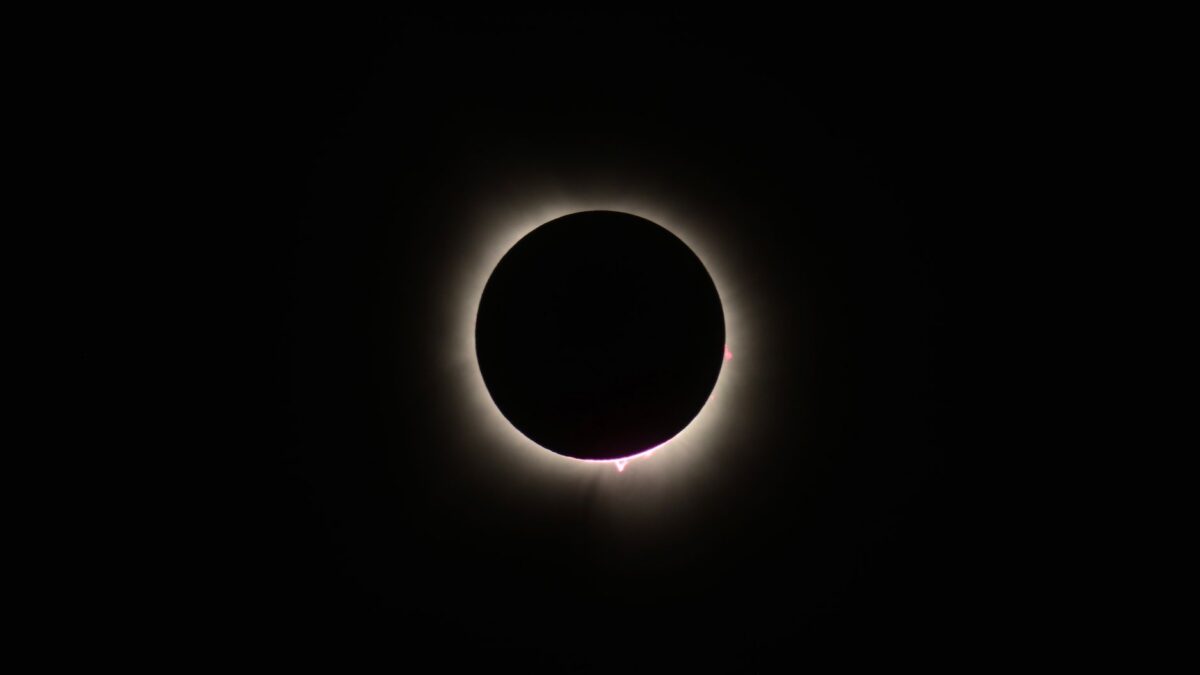
During a total solar eclipse the Moon covers the whole face of the Sun for a short time, usually a few minutes. Just before totality, beads of sunlight and a “diamond ring” flash at the Moon’s edge. Then the sky darkens like dusk, the Sun’s pale outer atmosphere, the corona, appears, and NASA says the air can cool by about 10°F (5°C). The next total eclipse is on August 2, 2027.
What you see depends on standing inside the narrow path of totality and on clear weather. Outside the path, the Sun is only partly covered and none of the totality effects appear.
What happens in the hour before totality?
A long partial eclipse comes first. For the April 2024 eclipse, NASA said the partial phase lasted between 70 and 80 minutes at most locations, from first contact to totality. The Moon takes a slowly growing bite out of the Sun, and through eclipse glasses the Sun turns into a narrowing crescent.
Daylight changes in ways that are easy to miss at first. Shadows sharpen, and the gaps between leaves on a tree project dozens of small crescents on the ground. In the last minutes the light turns dim and strange, and NASA notes that faint ripples called shadow bands can sometimes be seen moving across walls or the ground just before totality.
What are Baily’s beads and the diamond ring?
Baily’s beads are points of sunlight that shine through valleys along the Moon’s rugged edge in the final seconds before totality. As the last bead fades, one bright spot is left beside a thin glowing ring, which NASA calls the diamond ring. Both effects appear again, in reverse order, when totality ends.
These moments last only seconds. Keep your eclipse glasses on until the Sun is completely covered, and put them back on at the first flash of returning sunlight.
What does totality look like?
At second contact the Moon fully blocks the Sun’s bright face. Only then, according to the American Astronomical Society’s eye safety guidance, is it safe to remove your filter and look with your eyes.
- The corona. Streamers of white light spread out from behind the black disk of the Moon. This outer atmosphere of the Sun is normally lost in the glare.
- The chromosphere and prominences. NASA notes a thin pink rim may be visible at the Moon’s edge.
- Stars and planets. Bright planets and a few bright stars can appear in the darkened sky. Our guide to which planets are visible explains how to tell them apart.
- A 360-degree sunset. Beyond the shadow, sunlight still reaches the ground, so the whole horizon glows orange and yellow.
- A drop in temperature. NASA’s eclipse FAQ says the air can cool by about 10°F (5°C), depending on humidity and cloud cover.
- Animal reactions. Observers often report birds and other animals settling down as if evening had come.
How long can totality last?
Totality lasts from a few seconds to about 7.5 minutes, depending on the eclipse and where you stand in the path. The longest total eclipse in NASA’s eclipse catalog, which spans 4000 BCE to 6000 CE, comes on July 16, 2186, with about 7 minutes 29 seconds of totality.
Most eclipses fall well short of that. Totality in April 2024 lasted up to 4 minutes 28 seconds near Torreón, Mexico, according to NASA. Standing near the center line of the path gives the longest view; near the edges, totality can shrink to seconds.
How do you watch a total eclipse safely?
Look at the Sun only through solar viewers or eclipse glasses that meet the ISO 12312-2 standard, except during totality itself. Ordinary sunglasses, even very dark ones, are not safe.
- Buy eclipse glasses from a supplier on the AAS list and check them for scratches or holes before use.
- Wear them for the whole partial phase. Supervise children closely.
- Take them off only when the Sun is completely covered and the sky suddenly darkens.
- Put them back on as soon as the first bright point of the Sun reappears.
- Never look through binoculars, a telescope or a camera viewfinder without a proper solar filter on the front of the instrument, and never use them while wearing eclipse glasses.
- For an indirect view, use a pinhole projector, a colander or the dappled shade of a leafy tree, without looking at the Sun through the holes.
Outside the path of totality there is no safe moment to remove eye protection, because part of the Sun stays uncovered the whole time.
When is the next total solar eclipse?
The next total solar eclipse is on August 2, 2027, with a path across Morocco, southern Spain, North Africa and the Middle East, according to NASA’s eclipse tables. The most recent one, on August 12, 2026, crossed Greenland, Iceland and Spain. Durations below are the maximum at greatest eclipse; most places in each path see less.
| Date | Longest totality | Where totality falls |
|---|---|---|
| Aug 2, 2027 | 6 min 23 s | Morocco, Spain, Algeria, Libya, Egypt, Saudi Arabia, Yemen, Somalia |
| Jul 22, 2028 | 5 min 10 s | Australia, New Zealand |
| Nov 25, 2030 | 3 min 44 s | Botswana, South Africa, Australia |
| Mar 30, 2033 | 2 min 37 s | Eastern Russia, Alaska |
| Aug 23, 2044 | 2 min 04 s | Greenland, northern Canada, Montana, North Dakota |
| Aug 12, 2045 | 6 min 06 s | Southern US, Caribbean, northern South America, Brazil |
For the lower 48, the next totality comes on August 23, 2044, in Montana and North Dakota, followed by a long coast-to-coast eclipse on August 12, 2045. Our list of the next solar and lunar eclipses in the US has partial eclipses and lunar eclipses too.
Bottom line
A total solar eclipse builds through more than an hour of partial phases, then turns day to dusk in seconds. Baily’s beads and the diamond ring frame a few minutes of totality, when the corona, bright planets and a horizon-wide sunset appear and the air cools. Wear ISO 12312-2 glasses at every stage except totality. The next chance is August 2, 2027.
FAQ
Can I look at a total solar eclipse without glasses?
Only during totality, when the Moon fully covers the Sun. Before and after, and anywhere outside the path of totality, you need ISO 12312-2 eclipse glasses or a solar viewer.
How dark does it get during totality?
The sky looks like deep twilight. Bright planets and stars can appear, while the horizon in every direction stays lit by sunlight from outside the Moon’s shadow.
Do animals really react to an eclipse?
Observers often report animals acting as if evening had arrived, such as birds going quiet. Reactions vary by species and last only as long as the darkness.
When can people in the US next see a total solar eclipse?
Alaska gets one on March 30, 2033. The lower 48 waits until August 23, 2044, in Montana and North Dakota, and August 12, 2045, across the southern US, per NASA’s tables.