How Fast Do Days Get Longer After the Winter Solstice? Minute by Minute
Days lengthen by only seconds a day right after the winter solstice, then speed up to a few minutes a day by March. See how latitude changes the pace.
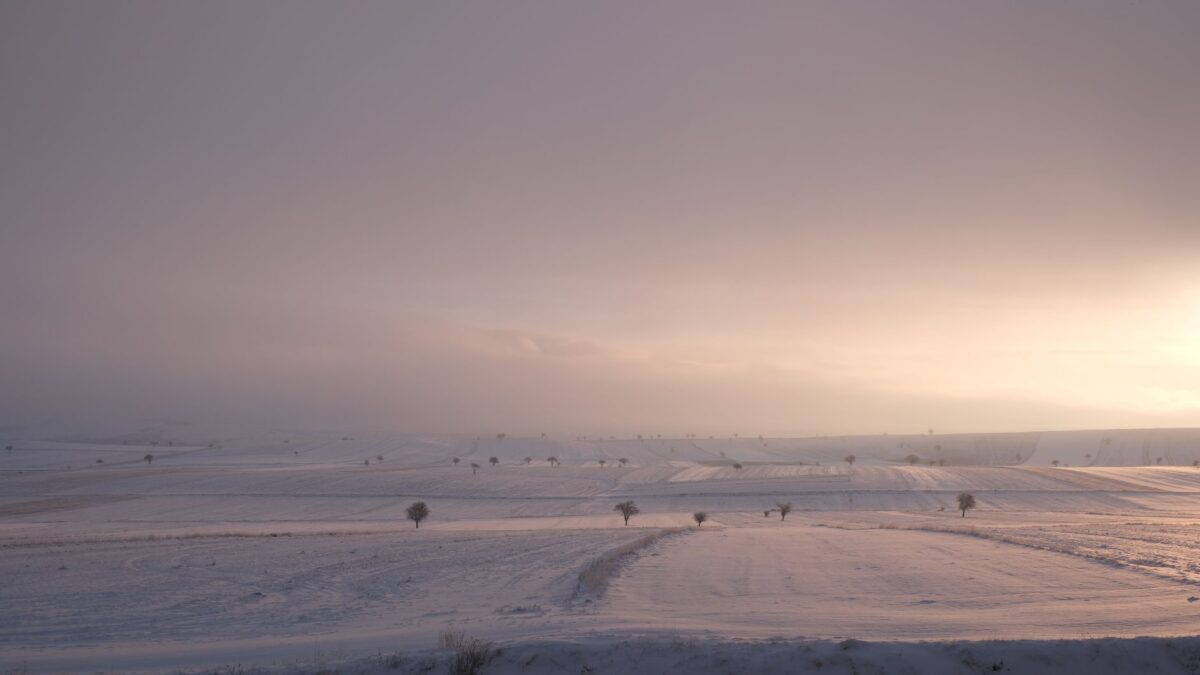
Days get longer very slowly right after the winter solstice: in the first few days the Northern Hemisphere gains only a few seconds of daylight per day. The pace then builds week by week, reaching roughly 2 to 3 minutes a day at mid-northern latitudes around the March equinox. At about 40 degrees north (Philadelphia, Denver, Madrid), daylight grows by only a minute or two in the first week after the solstice and by roughly half an hour by late January.
Why do days lengthen so slowly at first?
The Sun’s path across the sky changes slowly near a solstice. Earth’s axis is tilted about 23.4 degrees, and over the year the Sun’s position north or south of the celestial equator (its declination) swings between that limit and its mirror image. Near the solstice the Sun reaches the southern end of that swing and seems to pause there. The word solstice comes from Latin for “sun standing still.”
Because the Sun’s noon height barely changes for a week or so on either side of the turning point, the length of the day barely changes either. Picture a pendulum at the end of its arc: it moves slowest just before and after it turns. Around the equinoxes the Sun’s declination changes fastest, and that is when day length changes fastest too. Our explainer on why December 21 is the shortest day of the year covers the tilt in more detail.
How much daylight do you gain each week after the solstice?
At mid-northern latitudes the gains follow a rough pattern:
- First week after the solstice: a total gain of about 1 to 2 minutes, a few seconds per day.
- Early January: gains of under a minute per day.
- Mid to late January: around 1 to 2 minutes per day.
- February: about 2 minutes per day, a little more farther north.
- Around the March equinox: the fastest change of the year, about 2 to 3 minutes per day near 40 degrees north and close to 4 minutes per day near 50 degrees north.
A traditional shortcut called the rule of twelfths gives the overall shape. Divide the six months from solstice to solstice into six steps. In the first month after the winter solstice, day length rises by about one twelfth of the total change between the shortest and longest days. The second month adds two twelfths, the third and fourth add three twelfths each, the fifth adds two and the sixth adds one. It is an approximation, but it shows why January feels dark while March brightens quickly.
Why do sunsets get later before sunrises get earlier?
At mid-northern latitudes the earliest sunset of the year comes in early December, about two weeks before the solstice. The latest sunrise comes in early January, about two weeks after it. So in late December, evenings are already getting a little lighter while mornings are still getting darker.
The cause is a small mismatch called the equation of time. Earth’s orbit is an ellipse, and Earth is closest to the Sun in early January, when it moves fastest along its orbit. Combined with the axial tilt, this means solar noon (the moment the Sun is highest) drifts later on the clock through December and into January. Sunrise and sunset both drift later with it. Near the solstice, that drift is larger than the tiny change in total day length, so the afternoon gains first.
For people who leave work in the dark, the turn usually shows up in the evenings first. Morning commuters often notice nothing until mid-January.
Does latitude change how fast the days get longer?
Latitude has a large effect. The farther you are from the equator, the shorter your winter days and the faster they grow once they start. Near the equator day length stays close to 12 hours all year, so the solstice brings almost no change. In southern US cities the shift between December and March is modest. In Canada, Scandinavia and Scotland the winter days are much shorter and spring gains are much faster.
Above the Arctic Circle the Sun does not rise at all for a period around the winter solstice. That polar night lasts longer the closer a place is to the pole. When the Sun returns, day length there climbs very quickly, often by many minutes per day.
In the Southern Hemisphere everything is reversed. The December solstice is the longest day of the year there, and days start getting shorter, slowly at first.
When do days and nights become roughly equal again?
Day and night become roughly equal around the March equinox, which falls on March 19, 20 or 21. Because the atmosphere bends sunlight over the horizon and sunrise and sunset are measured from the top edge of the Sun, the day of exactly 12 hours of daylight usually comes a few days before the equinox in the Northern Hemisphere. After that, daylight keeps growing until the June solstice.
How can you check sunrise and sunset times for your town?
Official calculators give exact figures for any location. The NOAA Solar Calculator shows sunrise, sunset and solar noon for a point you choose on a map, and the US Naval Observatory publishes sunrise and sunset tables for a full year. Compare a date in late December with dates in late January and late February to see how quickly the gains build where you live. Published times assume a flat horizon, so hills, buildings and weather change what you see.
Some people find the short days hard. Our guide to how winter light affects mood and sleep explains how daylight affects mood in winter.
Quick answers
Is the winter solstice always on December 21?
The winter solstice falls on December 21 or 22 depending on the year and your time zone. The calendar does not match Earth’s orbit exactly, so the date shifts a little from year to year.
Why is it still getting colder after the days start getting longer?
Land and oceans keep losing more heat than they gain for several weeks after the solstice. That is why the coldest part of winter in much of the Northern Hemisphere usually comes in January or early February.
Did ancient people track the winter solstice?
Many did, and some built monuments aligned with the solstice sunrise or sunset. One famous example is the passage tomb in Ireland where sunlight fills a 5,000-year-old chamber at Newgrange for a few mornings around the solstice.
Which month gains the most daylight?
In the Northern Hemisphere, March gains the most daylight because the March equinox, when day length changes fastest, falls in the middle of it.
Site editor: Nikita Sheikin