Vera C. Rubin Observatory Explained: What Its Ten-Year Survey Maps
The Vera C. Rubin Observatory images the southern sky every few nights for ten years. Here is what it will catalog, from asteroids to supernovae.
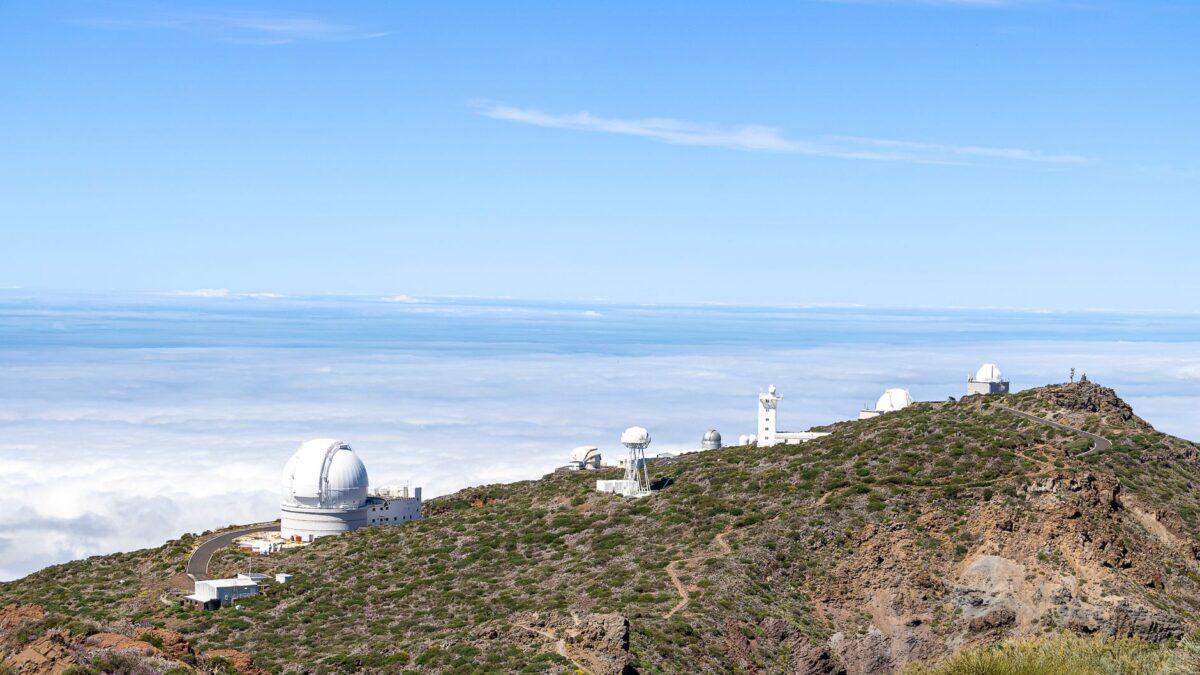
The Vera C. Rubin Observatory in Chile is photographing the southern sky every few nights for ten years, building a time-lapse record called the Legacy Survey of Space and Time (LSST). According to Wikipedia’s summary of the project, it is expected to catalog millions of supernovae and more than five million asteroids, and to image about 17 billion stars and 20 billion galaxies.
What is the Rubin Observatory?
Rubin is an astronomical observatory on El Peñón peak of Cerro Pachón, a 2,682-meter mountain in northern Chile’s Coquimbo Region. It sits next to the existing Gemini South and Southern Astrophysical Research Telescopes. The base facility is in La Serena, about 100 kilometers (62 miles) from the summit by road.
The observatory is named for Vera Rubin, the American astronomer who pioneered discoveries about how fast galaxies rotate. It is a joint initiative of the U.S. National Science Foundation (NSF) and the Department of Energy’s Office of Science, and it is operated jointly by NSF NOIRLab and SLAC National Accelerator Laboratory. Before 2019 the project was called the Large Synoptic Survey Telescope. Congress enacted the renaming as law on Dec. 20, 2019. “Synoptic” comes from Greek words meaning “together” and “view,” and describes observations that give a broad picture of a subject.
What is the telescope like?
The instrument is the Simonyi Survey Telescope, named for private donors Charles and Lisa Simonyi. It is a wide-field reflecting telescope with an 8.4-meter primary mirror. A variant of a three-mirror design keeps images sharp across a field of view 3.5 degrees in diameter.
The camera records those images on a 3.2-gigapixel charge-coupled device (CCD) sensor, the largest camera yet built. A charge-coupled device is the same kind of light-sensitive chip found in digital cameras, scaled up enormously. Rubin observes at wavelengths from 320 nanometers to 1,060 nanometers, which spans near-ultraviolet to near-infrared light.
How does the Legacy Survey of Space and Time work?
Rubin saw first light in June 2025, and system first-light images were released on June 23, 2025. Full survey operations followed in 2026. The sources disagree on the exact start: one passage says July 2026, another says June 30, 2026. Either way, the telescope now takes an image of the night sky every 40 seconds. That pace lets it scan the whole southern sky every few days, and repeat the scan for ten years.
The repetition is the point. Earlier sky surveys were catalogs: visually compiled lists in the 18th century such as the Messier catalog, then photographic plates starting with the 1885 Harvard Plate Collection, then digital surveys such as the Sloan Digital Sky Survey. Rubin adds time. Comparing the same patch of sky night after night shows what moves and what brightens or fades.
What will it find in the solar system?
The observatory is expected to catalog more than five million asteroids, including about 100,000 near-Earth objects. The original 2001 design set a goal of cataloging 90 percent of near-Earth objects larger than 300 meters and assessing the threat they pose to life on Earth. That early plan also expected to find some 10,000 primitive objects in the Kuiper Belt, a region that holds a fossil record of how the solar system formed.
For background on why impacts matter, see our explainer on the asteroid evidence behind the dinosaur extinction.
What will it find beyond the solar system?
The survey is expected to catalog millions of supernovae, the explosions of dying stars, as well as the 17 billion stars and 20 billion galaxies mentioned above. The 2001 design also called for studying the structure of the universe by observing thousands of supernovae, both nearby and at large redshift, and by measuring the distribution of dark matter through gravitational lensing. Gravitational lensing is the bending of light by mass, which lets astronomers map matter that gives off no light of its own.
The Department of Energy funded the camera, built by SLAC, as part of its mission to understand dark energy. The observatory’s name honors Rubin and her colleagues’ probes of dark matter, done by mapping and cataloging billions of galaxies through space and time. Readers who want the physics can start with what dark matter is and how scientists hunt for it, or with a recent result from another survey, the Dark Energy Survey finding cracks in cosmology’s standard model.
Who paid for it, and how long did it take?
The project was proposed in 2001. Mirror construction began in 2007 with private funds, and the LSST became the top-ranked large ground-based project in the 2010 Astrophysics Decadal Survey. Construction officially began on Aug. 1, 2014, with site work starting in April 2015. Funding came from the NSF, the DOE and private money raised by the LSST Discovery Alliance. Early gifts in January 2008 included $20 million from Charles and Lisa Simonyi and $10 million from Bill Gates. Construction cost was expected to be about $680 million.
The first pixel from the engineering camera arrived in October 2024. The source says COVID-related issues delayed the start of full operations. The Association of Universities for Research in Astronomy (AURA) manages operations.
How does Rubin differ from the James Webb Space Telescope?
Rubin is a ground-based survey instrument built to see a very large area repeatedly. A space telescope such as Webb studies selected targets in depth. Our guide to the James Webb Space Telescope covers that other approach.
Where to check
The observatory’s own website, rubinobservatory.org, is the place to look for current survey status and data releases, since figures such as expected object counts are projections that can change as the survey runs.
Based on the sources linked above, November 2026.
Site editor: Nikita Sheikin