Why Is Mistletoe a Parasite? How It Taps Trees for Water
Mistletoe is a hemiparasite: it makes its own sugar but drills into a host tree for water and minerals. How it spreads, harms trees and feeds wildlife.
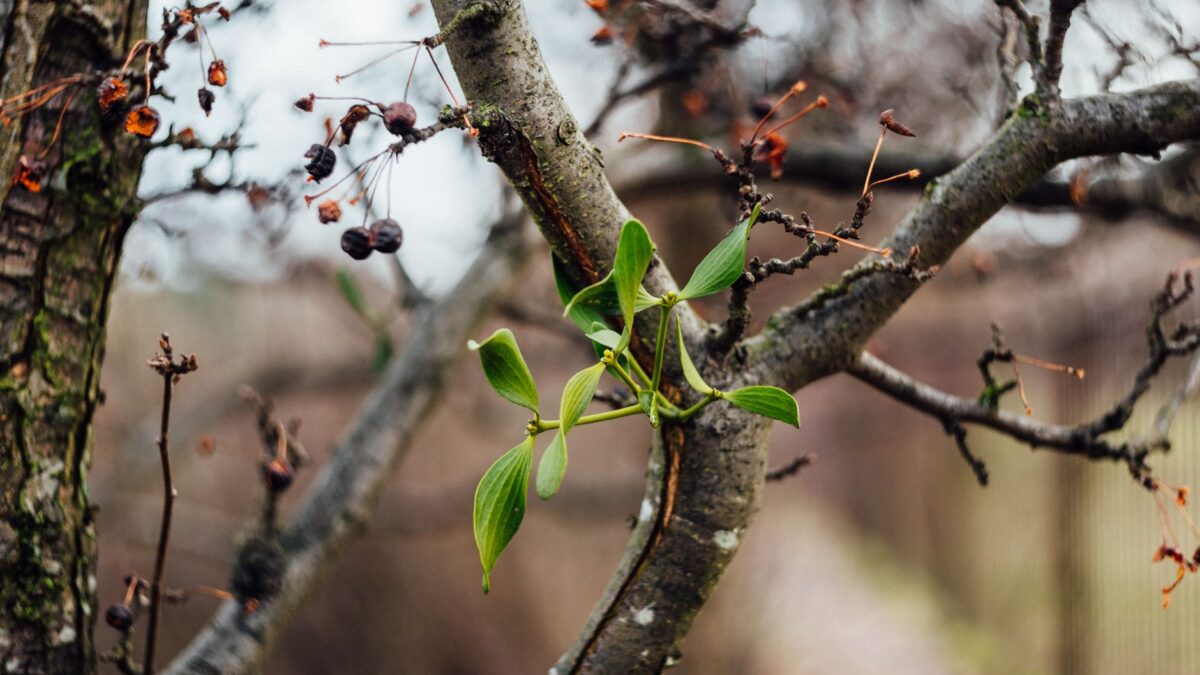
Mistletoe is a parasite because it cannot get water or minerals from the soil: it grows on the branches of a living tree and pushes a root-like organ called a haustorium into the wood to draw them from the host. Most mistletoes are hemiparasites. Their green leaves still make sugar by photosynthesis, so they take water and nutrients from the tree but feed themselves on light.
The holiday sprigs sold in December are usually American mistletoe (Phoradendron) in North America and European mistletoe (Viscum album) in Europe. Both live this way for their whole lives and die if the branch they grow on dies.
How does mistletoe attach to a tree?
Mistletoe attaches through a haustorium, a modified root that grows from the germinating seed straight into the branch. The sequence goes roughly like this:
- A seed lands on a twig, glued in place by a sticky coating called viscin.
- The seedling grows a small holdfast that presses against the bark.
- The haustorium grows through the bark and into the living wood.
- Strands spread along the branch under the bark and connect to the tree’s xylem, the tissue that carries water up from the roots.
After that connection forms, the mistletoe and the tree share the same water supply. Because the parasite tissue runs inside the branch, cutting off the visible clump does not remove it, and the plant can regrow from the same spot.
What does mistletoe take from the tree?
Mistletoe takes mainly water and dissolved minerals, such as nitrogen and potassium, from the host’s xylem. Leafy mistletoes keep their leaf pores open more than the host does, so they lose water faster and pull it toward themselves. That steady draw is the main source of harm.
Some mistletoes depend on the host far more. Dwarf mistletoes (Arceuthobium), which grow on pines, firs, spruces and other conifers in western North America, have tiny scale-like shoots with little chlorophyll. They take sugars from the tree as well as water, which places them close to full parasites.
Does mistletoe kill trees?
A few clumps of leafy mistletoe rarely kill a healthy tree, but a heavy infestation can weaken it, slow its growth and make it more likely to die during drought or insect attack. Signs of a tree under strain include:
- Swollen areas on branches where the mistletoe is attached
- Thinning foliage or dieback beyond the infected point
- Dense, twiggy clusters called witches’ brooms, common with dwarf mistletoe
- Many mistletoe clumps spreading through the upper crown
Dwarf mistletoes are counted among the most damaging disease agents of conifer forests in the western United States, and the USDA Forest Service tracks and manages them on federal land. Trees already stressed by drought, root problems or poor soil are hit hardest.
How does mistletoe spread from tree to tree?
Most mistletoes spread through birds. Birds eat the white or translucent berries, and the seeds pass through or stick to the bird’s beak. A bird wiping its beak on a twig, or dropping the seeds in its droppings, leaves them glued to a new branch by viscin. This explains why mistletoe often clusters in trees where birds perch.
Dwarf mistletoe uses a different method. Its ripe fruits build up water pressure and burst, shooting the seed sideways. Distances of up to about 50 feet (15 meters) are commonly reported, which lets the parasite move to nearby trees without animals.
Is mistletoe useful to wildlife?
Mistletoe is a significant food and shelter source in many forests. Its berries ripen in winter, when other fruit is scarce, and many birds eat them. In North America, the caterpillars of the great purple hairstreak butterfly feed on Phoradendron. Dense clumps and witches’ brooms give nesting and roosting spots to birds and small mammals, and some owls and squirrels use them regularly.
Mistletoe’s link with its host is a one-way trade. Trees also exchange resources with other organisms in ways that help both sides, as in the fungal networks described in how trees share food through fungi. Plants also send chemical signals, a topic covered in how plants communicate with each other.
How do you get rid of mistletoe on a yard tree?
Pruning out the infected branch is the most reliable method, because the parasite’s tissue grows inside the wood. Extension services generally advise cutting at least 12 inches (30 cm) below the point of attachment, since the strands spread along the branch past the visible clump. Other points to know:
- Breaking off the green clump only removes the shoots, and they usually regrow within a few years.
- Wrapping the cut area in black plastic to block light can kill the shoots on large limbs that cannot be removed.
- Large trees, high branches and work near power lines are jobs for a certified arborist.
- Removing mistletoe early, before berries form, reduces spread to other branches.
If you buy a cut evergreen for the holidays, those trees are farmed and managed separately; growing a Christmas tree takes years depending on the species.
Is holiday mistletoe poisonous?
Mistletoe is toxic to people and pets, and the berries and leaves should be kept away from children, dogs and cats. The ASPCA Animal Poison Control Center lists mistletoe as toxic to dogs, cats and horses, with possible vomiting, diarrhea, drooling and, in larger amounts, effects on heart rate and blood pressure. European mistletoe is generally considered more toxic than American mistletoe. Hang sprigs out of reach, sweep up fallen berries, and call a poison control line or a vet if someone eats part of the plant. Many decorative sprigs sold in stores are plastic for this reason.
Quick answers
Can mistletoe grow on its own in the ground?
No. Mistletoe seeds need a living host branch to germinate into a working plant, and a seedling that cannot reach the host’s water supply dies.
Which trees does mistletoe grow on?
American leafy mistletoe grows mainly on hardwoods such as oaks, maples, ashes and hackberries. Dwarf mistletoes grow on conifers, and each species tends to favor a narrow group of hosts.
Why does mistletoe stay green in winter?
Most mistletoes are evergreen, which makes them easy to spot in leafless deciduous trees. Their leaves keep photosynthesizing while the tree is dormant, using water still drawn from the host.
Is mistletoe the only parasitic plant?
No. Thousands of plant species are parasites, including dodder, broomrapes and Rafflesia, which produces one of the largest flowers in the world.
Site editor: Nikita Sheikin