Why Venus Looks So Bright in the Evening Sky: 3 Causes
Venus is so bright because its clouds reflect about 70% of sunlight and it passes close to Earth. See why it appears only at dusk or dawn.
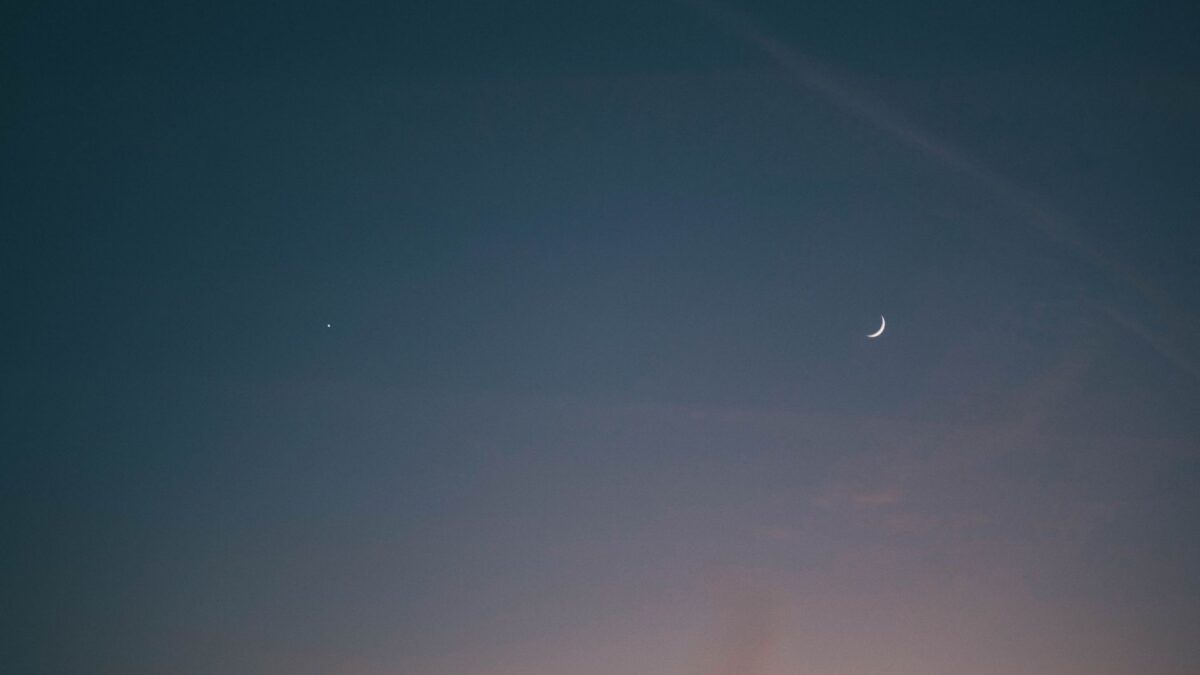
Venus looks so bright in the evening sky because three things stack up: a thick layer of reflective clouds, a position close to the Sun, and a path that brings it nearer to Earth than any other planet. Together they make it the brightest natural object in the night sky after the Moon, outshining every star.
It appears only near sunset or sunrise, never in the middle of the night, and that is part of the same story. The sections below take each cause in turn and explain why Venus sometimes sits in the west after dusk and sometimes in the east before dawn.
Why are Venus’s clouds so reflective?
Venus is wrapped in a continuous deck of clouds made mostly of sulfuric acid droplets, and these clouds bounce a large share of incoming sunlight straight back into space. Astronomers measure this with a number called albedo, the fraction of light a surface reflects. Venus reflects roughly 70% of the sunlight that reaches it. The Moon, a dark gray world by comparison, reflects only about 10% to 12%, and Earth about 30%.
The clouds also hide the surface completely. What you see from Earth, even through a large telescope, is the top of the cloud layer, which is smooth and bright with few features visible in ordinary light. A planet with a rocky, dark surface would look far dimmer from the same distance. NASA’s Venus overview describes the planet’s thick atmosphere and cloud cover in more detail.
How does distance from the Sun and Earth make Venus brighter?
Venus orbits the Sun at about 72% of Earth’s distance, so every square mile of its cloud tops receives roughly twice the sunlight that Earth gets. That light is then reflected toward us, and Venus is also the planet that comes closest to Earth, passing within tens of millions of miles at its nearest.
Brightness in astronomy falls off with distance, so a nearby, strongly lit, highly reflective world is a good recipe for a brilliant point of light. Mars and Jupiter can be bright too, but they are much farther from the Sun, and they cannot get as close to us as Venus does. Jupiter is large and reflective, yet it is still dimmer than Venus at its best.
How bright is Venus compared with stars and other planets?
Astronomers rate brightness on the magnitude scale, where lower numbers mean brighter objects and negative numbers are very bright. Venus reaches about magnitude -4.6 at its peak. Sirius, the brightest star in the night sky, is about -1.5. Jupiter peaks near -2.9, and Mars at its closest approach can reach about -2.9 as well.
Because the scale is logarithmic, a difference of five magnitudes means a factor of 100 in brightness. Venus at its best is many times brighter than Sirius. Under dark skies the planet can be bright enough to cast a faint shadow, and observers sometimes spot it in full daylight if they know exactly where to look and the sky is clear and blue.
Why does Venus appear only after sunset or before sunrise?
Venus orbits inside Earth’s orbit, so from our viewpoint it never wanders far from the Sun. The largest angle between the two, called greatest elongation, is about 47 degrees. That is why Venus never rises in the east at midnight, the way Mars or Jupiter can. It stays tied to the twilight sky.
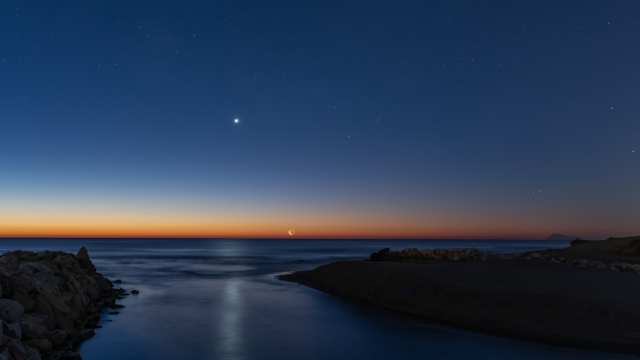
When Venus lies east of the Sun, it sets after the Sun does, and you see it low in the west after sunset as the "evening star." When it moves to the west side of the Sun, it rises before the Sun and appears in the east before dawn as the "morning star." It is a planet in both cases, not a star, and it is the same object.
How long does Venus stay in the evening sky?
An evening appearance lasts for several months, and the planet gradually climbs higher above the western horizon after sunset. Venus then swings back toward the Sun, drops lower each night, and disappears into the glare for a short while before reappearing in the morning sky. The full cycle of Venus returning to the same position relative to the Sun and Earth takes about 584 days.
The planet is not at its brightest when it looks fullest. Venus has phases like the Moon. When it is on the far side of the Sun, it appears small and nearly full. As it swings toward Earth, it grows larger in the sky but shows a thinner crescent. The brightest moment comes between those extremes, when the planet shows a partial crescent and is still fairly large. That happens a few weeks before and after it passes between Earth and the Sun.
How can you tell Venus from a plane or a star?
Look for a steady, silvery-white light low in the west after sunset. A few clues help separate Venus from other things in the sky:
- Venus does not twinkle much. Stars flicker because their light passes through turbulent air as a tiny point, while planets show a small disk that holds steadier.
- It does not blink or move quickly. An airplane shows flashing lights and crosses the sky in minutes.
- It is far brighter than anything near it. If a very bright light sits close to the horizon at dusk with no other stars visible, it is most likely Venus.
- Binoculars show a tiny disk or crescent shape. Hold them steady, and be sure the Sun has fully set before pointing them anywhere near the western horizon.
Bright fireballs and meteors can also rival Venus for a moment, but they streak across the sky and vanish, unlike a planet. Reports of Taurid fireballs as bright as Venus describe exactly that comparison. If you are planning to watch the sky after dusk, a guide on how to see a comet in the sky covers the same basics: a dark site, a clear horizon and a few minutes for your eyes to adjust.
Common questions
Is Venus a star?
No. Venus is a planet. It shines by reflecting sunlight, while stars produce their own light. It looks starlike only because it is so far away that it appears as a point to the naked eye.
Why is Venus called the evening star and the morning star?
The names describe when it is visible, not what it is. When Venus sits east of the Sun, it shows up after sunset. When it sits west of the Sun, it shows up before sunrise. Ancient observers often thought these were two separate objects.
Can I see Venus without a telescope?
Yes. Venus is easy to find with the naked eye when it is above the horizon in twilight, since it is the brightest point in the sky other than the Moon. A small telescope or steady binoculars will show its phase, which looks like a tiny Moon.
Site editor: Nikita Sheikin