How Wood Frogs Survive Freezing Solid: Glucose, Ice and Pause
Wood frogs survive winter by letting about two thirds of their body water freeze, using glucose as antifreeze. Here is how thawing back to life works.
Wood frogs (Rana sylvatica) survive winter by letting a large share of their body water turn to ice, often cited as around two thirds. While frozen, their heart stops and they do not breathe. Sugar in their cells, mainly glucose, protects the tissues, and in spring the frog thaws and hops away.
Few vertebrates can do this. The sections below answer the questions people ask most about it.
Where do wood frogs live, and why do they need to freeze?
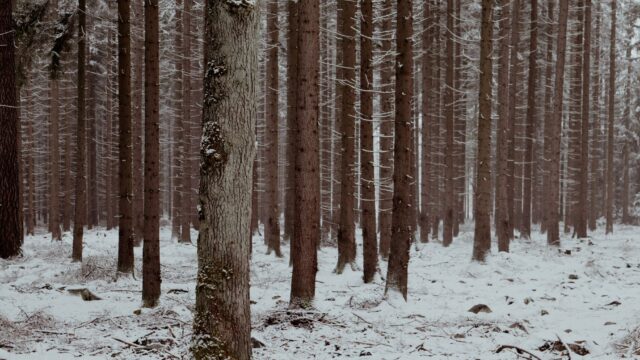
Wood frogs live in forests across much of North America, reaching farther north than any other North American amphibian, including areas near the Arctic Circle. In those places the ground freezes in winter, and a small frog cannot dig below the frost line the way some animals can.
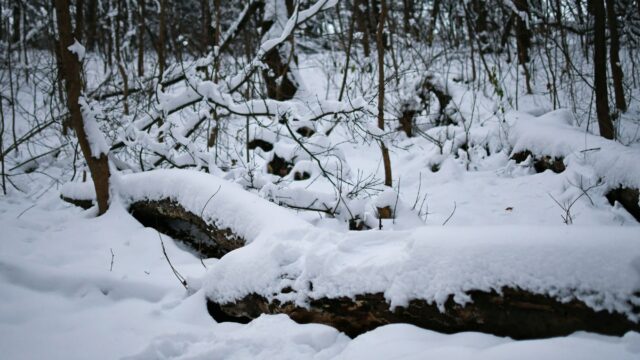
Instead of burrowing deep, a wood frog settles into leaf litter on the forest floor. Leaves and snow cover act as a blanket, but the frog still ends up at or below freezing temperatures, so its body has to cope with ice.
That is a different strategy from the one used by animals that go underground or slow down while staying liquid. If you want to compare approaches, see this explainer on hibernation, torpor and brumation.
What actually freezes inside the frog?
Ice forms in the spaces between cells, in the abdominal cavity and under the skin, rather than inside the cells themselves. Ice inside a cell would rupture it, so the frog’s chemistry steers freezing to the outside.
As water leaves the cells to join the growing ice, the cells shrink. This is a risk too, because over-shrunk cells are damaged. The frog’s antifreeze compounds limit how much water leaves.
The frozen frog looks like a stiff lump. Its eyes can look cloudy, and its body is hard to the touch.
How does glucose protect the frog?
When ice starts to form on the skin, the frog’s liver converts stored glycogen into large amounts of glucose and releases it into the blood. Glucose floods the body and builds up inside cells. Dissolved sugar lowers the freezing point of the fluid and holds water inside cells, so cells shrink less and are less likely to freeze.
Wood frogs also build up urea during winter, a waste product that works as an additional protective solute. Both compounds act like natural antifreeze, although they do not stop freezing entirely. They keep it controlled and survivable.
This is why a wood frog that is thawed in spring has a very high blood sugar level for a while. Healthy frogs clear it after they thaw.
How can a frog be alive with no heartbeat?
While frozen, the frog’s heartbeat stops, blood stops circulating, breathing stops and brain activity drops to a level that cannot be detected by ordinary measures. Metabolism slows to a crawl, and the cells need very little oxygen.
It helps to call this a pause rather than ordinary death. The tissues are preserved in a protected state, and when the ice melts the heart starts beating again. Thawing begins on the outside and moves inward. The heart and the rest of the body restart in an orderly way over hours, and the frog regains movement over a longer period.
Not every frog survives. A wood frog can handle winter freezing and thawing, but it cannot tolerate every temperature. Very deep cold or a freeze that lasts too long can kill even this species, and repeated freeze and thaw cycles during a mild, unstable winter cost it energy.
Do other animals freeze like this?
A few other frogs, such as spring peepers and gray treefrogs, are also freeze tolerant, as are some turtles and insects. Most other frogs avoid freezing. Many aquatic frogs overwinter under water, where the temperature stays above freezing, and breathe through their skin. Many other amphibians and reptiles seek shelter below the frost line.
The wood frog is the best studied because it tolerates freezing for weeks and shows the strongest response. Researchers study it to understand how cells and organs can survive freezing, with an eye on better ways to preserve donated organs. Those applications are still in the research stage.
What do wood frogs do after thawing?
Wood frogs are among the first amphibians to breed in spring. They often head straight to temporary woodland pools, called vernal pools, soon after thaw. Males call, females lay egg masses, and the pools dry out later in the year, which keeps fish away from the tadpoles.
Frogs are also food for many predators. The scale of that is visible in the fossil record, for example in a ditch where birds of prey left thousands of Roman-era frog bones.
For range maps and species profiles, see the U.S. Geological Survey, which tracks amphibian populations in North America.
Quick answers
Can you thaw a frozen wood frog yourself?
You should leave a frog you find frozen where it is. Frogs in winter shelter are in a protected state, and moving or warming them can make them thaw at the wrong time. If a frog is exposed on a path, move it a short distance into leaf litter.
Do wood frogs freeze every winter?
They can freeze many times in a winter if temperatures rise and fall. Each freeze and thaw uses stored energy, so a long run of warm spells and cold snaps is harder on them than steady cold with good snow cover.
What temperature can a wood frog survive?
Wood frogs survive being frozen at temperatures a few degrees below freezing for days or weeks. Their limit is not far below that, and the exact figure depends on the individual and how fast it cools. No frog survives freezing without its glucose response.
Is a frozen frog dead?
No. Biologists describe the frozen state as suspended life, since tissues are preserved and the frog recovers when it warms up.
Site editor: Nikita Sheikin